Six days after the market infrastructure that already clears most U.S. equities and Treasuries opened a tokenization rail, Morgan Stanley said it is among the first banks to put those assets into token form. The point is not that stocks suddenly live on a public chain. It is that the official custodian is minting digital twins of positions it already holds, with the same rights attached, and that a major broker-dealer has started using that rail.
What DTCC launched
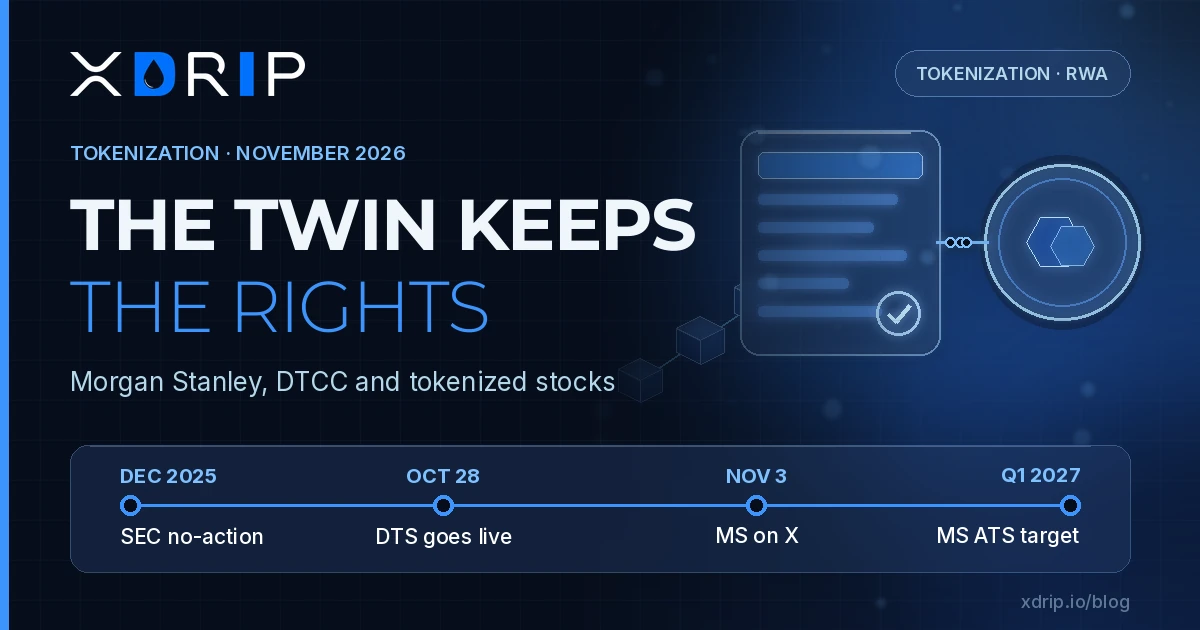
On 28 October the Depository Trust Company (DTC), a subsidiary of The Depository Trust & Clearing Corporation (DTCC), launched the DTCC Tokenization Service (DTS). In DTCC’s words, the service creates “tokenized representations of DTC-custodied securities to support greater liquidity, collateral mobility and capital efficiency.” Eligible users can mint those representations, convert them between traditional book-entry and token form, and deliver them to digital wallets of their choice.
DTCC calls the tokens “digital twins.” They are meant to retain the ownership rights, investor protections and economic entitlements of the underlying securities. According to Unchained, each twin is backed 1:1 by a security DTC already holds, keeps the underlying CUSIP, and leaves DTC as the official record keeper. That is a different design from wrapping an asset elsewhere and hoping the wrapper still maps cleanly to the registered interest. Custody stays at DTC. The token is a convertible form of an entitlement that already sits on regulated market infrastructure.
DTC today has more than $114 trillion in assets under custody. The December 2025 SEC no-action letter that cleared the path for DTS covers Russell 1000 constituents, exchange-traded funds that track major indices, and U.S. Treasury securities. About seven months after that letter, DTCC and more than 30 firms completed initial limited-production trades and on-chain transactions before the 28 October go-live.
Who is on the rail
At launch, 20 DTC participants had signed agreements to access DTS. The list published by DTCC includes Alpaca, Apex Clearing, Barclays, Bank of America, BNP Paribas, Brown Brothers Harriman, Citadel Securities, Citi, Clear Street, DriveWealth, Edward Jones, Fidelity Investments, Interchange Clearing, J.P. Morgan, Marex, Mirae Asset Securities (USA), Morgan Stanley, State Street, UBS and Velocity Capital. Future users are to be onboarded on a rolling basis. DTCC also named a wider set of collaborators — wallet, application and technology firms — that sit around the service rather than as DTC participants themselves.
Signing an agreement is not the same as running live conversions. DTCC’s launch release named the 20 as signed participants; it did not name which of them had already tokenized. That is the step Morgan Stanley took this week.
What Morgan Stanley said
In a post on X on 3 November, Morgan Stanley said it is among the first banks to tokenize real-world assets through DTS, naming U.S. equities and U.S. Treasuries. The post did not name specific securities, amounts or which network carried the tokens, and it did not say whether the positions were for clients or for the bank. CoinDesk, The Block and FinanceFeeds all reported the same announcement.
Amy Oldenburg, Morgan Stanley’s head of digital assets strategy, said: “The hands-on experience of integrating tokenized securities with established market infrastructure will inform the continued development of the firm’s digital asset capabilities as the market evolves.” Separately, Morgan Stanley expects to support tokenized equities on its alternative trading system in the first quarter of 2027, later than an earlier second-half 2026 target, according to The Block and FinanceFeeds.
The rails under the twins
DTS runs on a multi-network model. At launch it is integrated with the Canton Network and with DTCC’s private Besu network, with additional networks planned for 2027. Unchained notes that Stellar and Circle’s Arc are among the names expected later; DTCC itself has described its longer roadmap — on-chain netting, digital cash, wider settlement and collateral uses — as indicative and subject to change.
The regulatory perimeter matters as much as the network list. The SEC no-action scope is specific: large-cap equities in the Russell 1000, major-index ETFs, and Treasuries. That is not a general licence to tokenize anything DTC holds. It is a bounded path for the assets that already dominate collateral, liquidity and institutional portfolios.
Why the design matters
Tokenization of real-world assets has often meant one of two things: a claim on an off-platform custodian that is hard to audit from the chain, or a wrapper that does not carry the same legal entitlements as the registered security. DTS is an attempt at a third pattern. The custodian is the same entity that already keeps the official record for most U.S. equity and Treasury positions. Convertibility is built in. Rights and CUSIP travel with the twin. The token is not a substitute for the book-entry interest; it is another form of it.
DTCC’s stated goals for that design are practical rather than theatrical: move assets more efficiently, open new liquidity pools, and mobilize collateral within minutes. Whether those gains show up at scale depends on how many of the 20 signed participants actually convert positions, how settlement and collateral workflows plug in, and how the 2027 network and product roadmap lands. Morgan Stanley’s post is an early data point that at least one large bank has moved from the participant list to stated use.
Our view
We have argued for some time that tokenization only scales when the on-chain representation stays tied to a trustworthy record of ownership. Wrapping an asset without preserving rights, convertibility and the official record keeper is a demo. Minting a twin on the infrastructure that already clears and custodians the U.S. market is closer to the design institutions can put capital behind.
As XDRIP Digital Management LLC, we build products and infrastructure for a world in which regulated market rails and digital-asset tooling have to work together. We do not run DTS, and we are not a party to Morgan Stanley’s conversions. We do watch this class of launch closely, because it sets the bar for what “tokenized equity” and “tokenized Treasury” will mean in practice: same rights, same CUSIP, custody at DTC, convertibility both ways. That is the path that can carry institutional size without asking investors to give up the protections they already have.
Sources
- DTCC, DTCC Tokenization Service Goes Live (28 October 2026)
- CoinDesk, Morgan Stanley says it is among the first banks to tokenize real world assets (4 November 2026)
- The Block, Morgan Stanley among first banks to tokenize US equities, Treasurys through DTCC's service (4 November 2026)
- Unchained via Yahoo Finance, Six Days After Launch, Morgan Stanley Says It Is Using DTCC’s Tokenization Service (4 November 2026)
- FinanceFeeds, Morgan Stanley Tokenizes US Equities and Treasuries Through DTCC Service (4 November 2026)