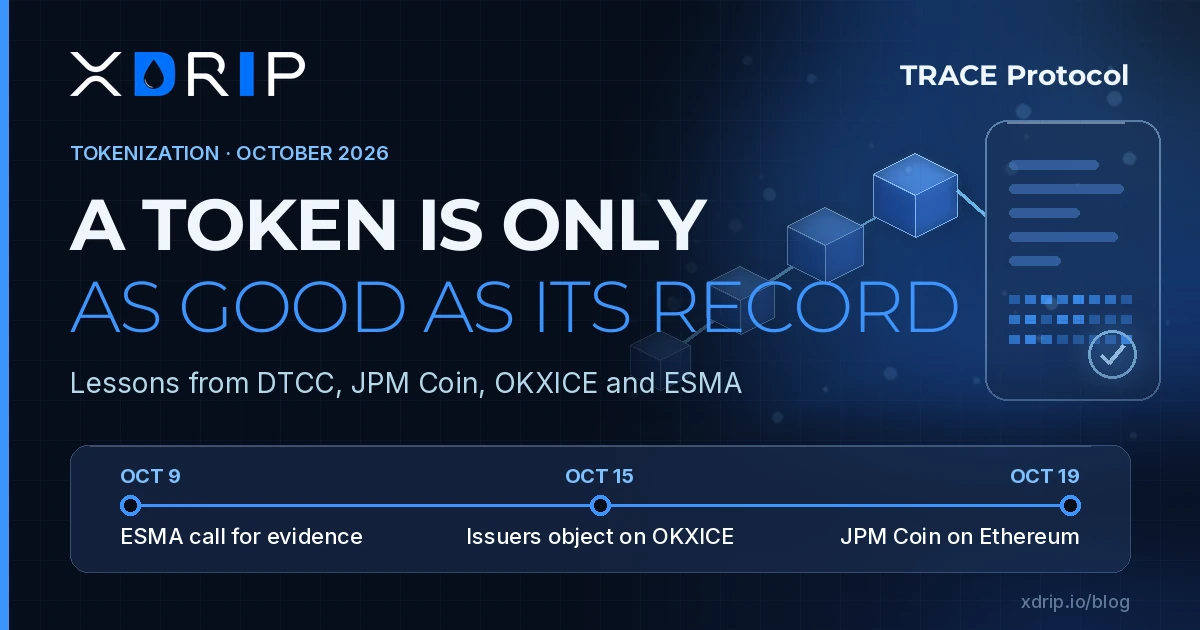
Tokenization had a busy week. The plumbing of US securities markets opened a tokenization service, the largest US bank put its deposit token on Ethereum, nine listed companies objected to tokenized versions of their own shares, and Europe's markets regulator asked what happens to tokenized collateral when something breaks. Read together, these stories make one point clearly: issuing a token is the easy part. What matters is the record behind it.
The infrastructure is going live
The Depository Trust & Clearing Corporation (DTCC) has spent 2026 moving its tokenization service from pilot to production. In December 2025 its subsidiary DTC received an SEC no-action letter covering Russell 1000 stocks, major index ETFs and US Treasuries, and DTCC committed to tokens that carry "the same entitlements, investor protections and ownership rights" as the assets in traditional form (DTCC, May 2026). After live production trades with more than 30 firms in July (DTCC, July 2026), the service is opening this month, starting with 25 liquid instruments on Canton and DTCC's private Besu network, each token backed one-to-one by securities held at the depository (Telem).
On 19 October, Kinexys by J.P. Morgan brought JPM Coin (JPMD), its US dollar deposit token, to Ethereum mainnet for institutional clients, alongside Base, where it launched in November 2025 (J.P. Morgan). The bank's own product page carries a telling line: tokens with the same or similar name at different contract addresses are not affiliated with J.P. Morgan (JPM Coin product page). On a public chain, anyone can deploy a token called almost anything. The only thing that makes one genuine is a verifiable link back to the issuer.
When the issuer says no
The same week showed why that link matters. In a 15 October public notice, OKXICE, the planned tokenized-stock venue from OKX and Intercontinental Exchange, listed nine companies that have objected to having their shares traded on it, among them Broadcom, Verizon, CoreWeave and UnitedHealth Group. The tokens would be backed one-for-one by the underlying stock under the SEC's Innovation Exemption, yet the issuers still said no, without disclosing why (CoinDesk).
Backing alone, then, is not the whole story. The episode highlights a basic question that code cannot answer on its own: does the token represent what it claims to represent, and does the party it refers to agree?
The hard part is what happens when things go wrong
Europe is asking the same question from the other end. On 9 October, the European Securities and Markets Authority (ESMA) launched a call for evidence on whether central counterparties can safely accept tokenized collateral (ESMA). Its focus is not whether tokens can move, but whether a clearing house could still access, transfer and turn them into cash if a clearing member defaults, and how client segregation and settlement finality hold up where a ledger meets traditional infrastructure. Responses are due by 15 January 2027.
That is the right question. A token that moves in seconds is only useful if everyone can rely on what it represents, who stands behind it and what happens on the worst day.
Three questions for any token
Whether it represents a Treasury bill, a bank deposit, a share or a collectible, we think every token should be able to answer three questions:
- Who stands behind it? A named issuer, a published contract address and a way to check that the token you hold is the official one.
- What exactly does it represent? The asset, the rights attached to it and the rules that apply, written down and published before anyone relies on them.
- Can its history be verified? A record of when it was created, what changed and who changed it, that cannot be quietly edited after the fact.
None of these are blockchain features by default. A smart contract can enforce rules, but it cannot tell you whether those rules match the real-world agreement. The record has to be built deliberately.
How we approach it
This is the principle behind how we build at XDRIP. Our Digital Ownership Tokens (DOTs) are collectible and utility records for provenance, access and project-specific documentation, and we publish the collection rules and utility for each project so holders know what a token stands for.
Our TRACE Protocol, currently in development and used internally across our platforms, addresses the third question directly. When a document is registered, a cryptographic hash is generated and anchored on-chain with a timestamp. Any later change to the document produces a different hash, so tampering becomes visible, and each modification, transfer and verification event adds to a traceable chain of custody.
Tokenization is moving from experiments into the core of financial markets. The projects that last will be the ones whose tokens can show, at any moment, where they came from and what they mean.