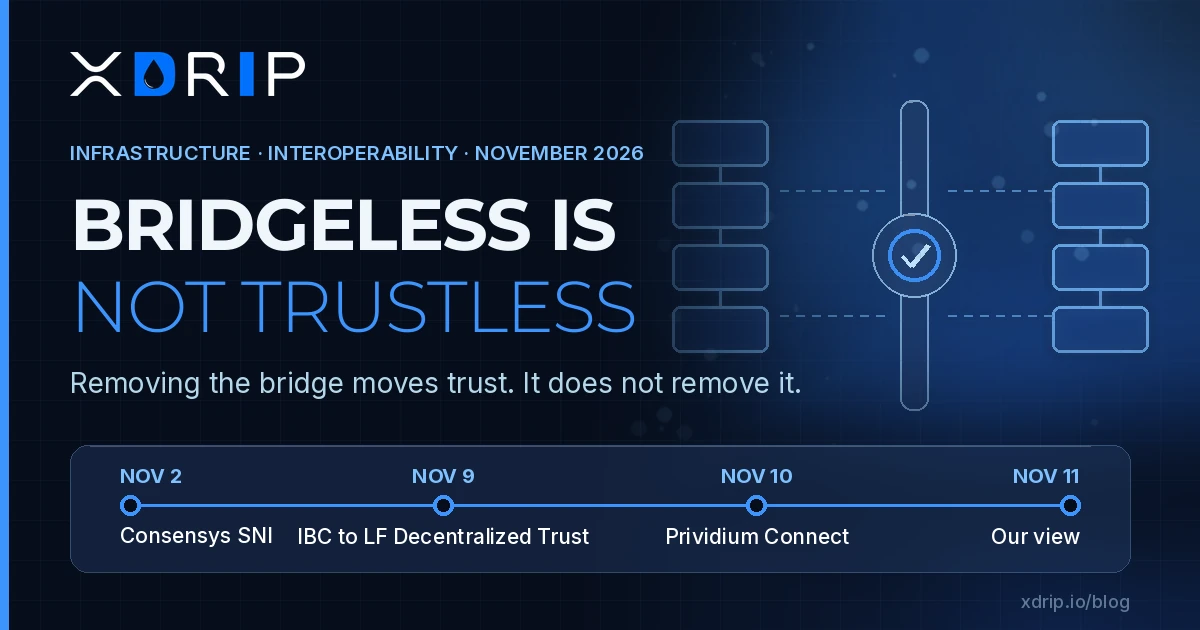
In nine days, three of the larger names in blockchain infrastructure made the same argument in different ways. Consensys launched a stack for settling between institutional ledgers without moving assets off them. Cosmos handed its cross-chain protocol, IBC, to neutral open governance. Matter Labs, the developer behind ZKsync, put a private cross-chain settlement product on mainnet. None of them is pitching a better bridge. Each is trying to make the bridge, in the sense of a pool of assets held by someone in the middle, unnecessary.
We think that is the right direction. We also think the word "bridgeless" deserves a careful reading, because removing a bridge does not remove trust. It moves it.
Three launches, one direction
On 2 November, at Devcon in Mumbai, Consensys introduced Sovereign Network Interoperability, a stack for routing and coordinating transactions across ledgers that banks, custodians and market infrastructures run themselves. An institution states what it wants to do, with which approved counterparties and under what settlement terms; the product selects a route, coordinates execution on each ledger and tracks the result. Consensys names four workflows: collateral mobility, securities delivery against payment, cross-currency payments and fund servicing. Assets stay on their native ledgers, and cross-ledger state is checked with proofs through its Cross Ledger Interoperability Protocol (CLIP). According to the company's Q&A, EVM-based chains are supported now, with Canton coming next.
On 9 November, Cosmos and the Interchain Foundation announced that the Inter-Blockchain Communication protocol is being contributed to LF Decentralized Trust, the Linux Foundation's organisation for decentralized technologies. The move is supported by Google Cloud and by individuals from organisations including Wells Fargo, Figure Markets, OpenZeppelin and the Cardano Foundation. According to the announcement, IBC has processed more than $50 billion in volume across more than 115 networks since 2021, and its users include a tokenized deposit platform in Japan and the Progmat issuance platform backed by Mizuho, MUFG and Japan Exchange Group.
On 10 November, Matter Labs introduced Prividium Connect. Two institutions on different chains agree an exchange; zero-knowledge proofs must show the agreed terms were met before it can complete, so either both transfers happen or neither does. If an exchange misses its deadline, each side can recover what it committed without the other's cooperation. Confidential balances and client records stay in each institution's own systems. Support starts with Hyperledger Besu and Prividium Ledger. As DeFi Prime noted, the proposed public deployments and the plan to route fees into the ZK token still need governance approval, so the launch and the token economics are separate questions.
Why the industry is walking away from the pool
The classic bridge locks assets on one chain and issues a representation on another. That creates a large pool of value whose release depends on whoever signs, or whatever software attests, that a transfer is valid. Matter Labs' own announcement cites 107 security incidents and $1.18 billion in losses across the digital-asset sector in the third quarter of 2026, and argues that bridges and intermediaries "expose assets to failures outside the institution's control".
The alternative these launches share is coordination rather than custody. Instead of moving an asset into someone else's escrow, the two ledgers are made to agree on an outcome, and the asset only changes hands when the conditions are proven. For tokenized securities, collateral and fund units, that is a much closer match to how settlement is supposed to work: delivery against payment, not delivery and hope.
Bridgeless does not mean trustless
The most useful line in this month's announcements is in Consensys's own Q&A. Asked what an institution would still need to trust, it answers that participating ledgers, their consensus, verification software and operational controls "still have defined trust assumptions". That is an honest answer, and it applies to every design here.
Proofs verify what they are built to verify. Prividium Connect makes the point itself: confirming what another chain recorded is not the same as proving that a counterparty fulfilled its obligations, which is why it proves execution against the agreed terms. Connectors still run inside each institution's perimeter. Settlement layers still need to reach finality. Somebody still maintains the adapters, ships the upgrades and holds the keys that operate each piece. Even a mature protocol can be undermined at the edges: this week XDRIP Central covered how an attacker reached the infrastructure that signs rollup withdrawals on Initia, and the chain accepted forged withdrawals as valid. No smart contract had to break.
Governance is part of the trust model too. Moving IBC under neutral stewardship means no single company controls the roadmap of a protocol that banks and market infrastructures are being asked to depend on. That matters as much as any cryptographic property, because a standard is only as durable as the process that changes it.
The questions we ask of any cross-chain path
When we evaluate how tokenized assets and records should move between networks, we read announcements like these against five questions.
- Where does the asset sit during the transfer? On its native ledger, under conditions both sides can verify, or in a pool someone else controls?
- What exactly is proven? That a message was sent, that a state was recorded, or that the agreed obligation was met?
- What happens if it stalls? Can each party recover its own assets on its own, by a known deadline, without waiting for a counterparty or an operator?
- Who holds the operating keys? Every connector, relayer and upgrade path has one. Which of them could release or freeze value, and how are they protected?
- Who governs the rules? A single vendor, a token vote, or a neutral open process, and how are changes reviewed before they reach production?
None of the three launches answers all five perfectly, and none claims to. What they do show is a shift in the default: from trusting the middle to verifying the outcome. For anyone building on tokenized assets, that is a better starting point, as long as the trust that remains is named, owned and protected rather than assumed away.