For most of the past two years, tokenization headlines have been about the asset: a fund, a bond, a share class brought on-chain. This week the more interesting news was about the other side of the trade. On 19 November the Monetary Authority of Singapore reported that it had issued government bills natively on a shared ledger and settled them in wholesale central bank money. A day later, Maybank completed Malaysia's first tokenized government securities trade, paid with tokenized deposits. In between, Invesco launched a tokenized money market fund built to hold the reserves behind payment stablecoins.
We think these three announcements point to the same conclusion. A tokenized bond is only half a transaction. Until the money that pays for it lives on a ledger with the same rules, the efficiency that tokenization promises stays mostly on paper.
Singapore issues on the ledger, and pays on it too
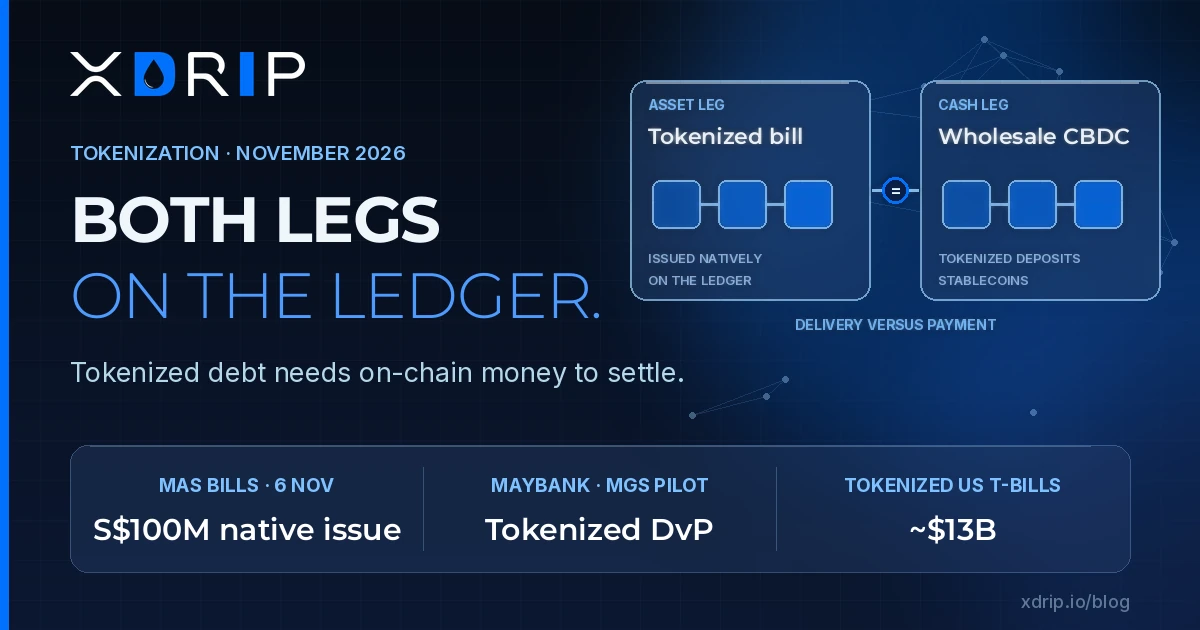
According to MAS, S$100 million of four-week MAS Bills were issued on 6 November directly on the MAS-operated Singapore Dollar Test Network and settled using wholesale central bank digital currency. Five primary dealers took part (DBS, HSBC, OCBC, Standard Chartered and UOB), applications came in at more than double the issue size, and the bills mature on 4 December.
Two details in the release matter more than the size. First, the bills were issued natively, which MAS says "eliminates the need for reconciliation and intermediaries, unlike instruments that are issued conventionally and tokenised subsequently." Second, the bills were paid for in central bank money on the same network, so the asset leg and the cash leg settled in one place.
In his keynote at the Singapore FinTech Festival, MAS Managing Director Chia Der Jiun was candid about where the market stands: "the value of tokenised financial assets remains small relative to that of conventional markets." He listed three conditions for scale: commercially compelling use cases, trusted forms of digital money, and interoperable infrastructure for settlement. He also announced that the test network will be renamed SG Digital Ledger and repositioned as an operational utility, and that MAS and industry partners had published the Guardian Tokenised Collateral Framework covering operational requirements across the collateral life cycle, including eligibility, custody, valuation and enforcement.
Two of those three conditions are about money and settlement, not about the asset.
Malaysia composes the trade from tokenized parts
The Maybank pilot, carried out with its insurance arm Etiqa under Bank Negara Malaysia's Digital Asset Innovation Hub, is a useful contrast. According to The Star, the trade showed how "tokenised securities, tokenised deposits and custody processes" can be combined into a programmable delivery-versus-payment workflow that spans on-chain and conventional infrastructure. Maybank also held the underlying physical cash and securities in custody.
That last point is the honest part of the story. The tokenized Malaysian Government Securities are representations of instruments that still exist in the conventional system, and the tokenized deposits represent bank money that still sits on the bank's books. Delivery-versus-payment, the rule that the security moves only if the money moves, can be enforced by code on the ledger. But the result is only as reliable as the link between each token and the record it represents.
Japan weighs which kind of bond to put on-chain
The same distinction runs through Japan's plans. In a report covered by The Block on 16 November, Standard Chartered's Geoffrey Kendrick noted that Japan's Ministry of Finance held its first study group meeting on on-chain government bonds on 8 October and is weighing three paths: tokenize existing bonds, issue new bonds directly on a distributed ledger, or do both. Tokenizing existing bonds is simpler because the legal structure and cash flows stay the same. Native issuance could save more work and cost.
Kendrick put tokenized US Treasury bills at around $13 billion and tokenized government debt outside the US at just under $1 billion, with almost no longer-dated debt on-chain so far. The bank sees the tokenized real-world asset market at around $45 billion today and keeps its forecast of $2 trillion by the end of 2028. That forecast is a projection, not a fact, and it depends on exactly the question Singapore just tested: whether issuers are willing to make the ledger the primary record rather than a copy of it.
A fund that sits behind the money
Invesco's launch shows the cash leg from another angle. As DeFi Prime reports, the Invesco Stablecoin Reserves Onchain Fund launched on 17 November as a registered government money market fund whose shares are represented by IROXX on Ethereum through Superstate. It is designed for stablecoin issuers to hold eligible reserve assets, with a $1,000,000 minimum and subscriptions and redemptions in dollars or USDC.
The prospectus details show what "on-chain" means in practice for a regulated product:
- The official shareholder register is the on-chain ownership record together with an off-chain register that links wallet addresses to shareholder identities.
- The network is public, but the shares are permissioned: only registered, approved wallets on an allowlist can hold or transfer them.
- The smart contracts can freeze shares and burn and re-mint them when an investor loses control of a wallet. The prospectus still warns of irreversible losses if a stolen key is used to move shares and redeem them.
- The Bank of New York remains custodian and fund administrator, alongside the blockchain recordkeeping.
Put simply, if stablecoins become one of the settlement assets for tokenized markets, the reserves behind them are moving on-chain as well, under conventional controls.
Distribution still runs through regulated gates
The WisdomTree announcement on 18 November fits the same pattern. Three tokenized funds were registered in Singapore as restricted schemes, available to accredited and other eligible investors through regulated intermediaries, starting with Pinetree Securities. The tokens represent interests in existing funds; the strategies are unchanged, and only the distribution and recordkeeping rails differ. The announcement did not name the blockchains to be used in Singapore.
What we take from the week
Seen together, these launches suggest the industry is moving past the question of whether an asset can be represented on a ledger. The harder questions are now about settlement and records:
- Which money settles the trade? Wholesale central bank money, tokenized deposits and regulated stablecoins each carry different risks and different operators. MAS names all three; Singapore and Malaysia used two of them this month.
- Which record is authoritative? A natively issued bill has one record. A tokenized version of an existing bond has two that must agree. Invesco's register is explicitly split between the chain and an off-chain identity file.
- Who can intervene? Allowlists, freezes and re-minting are features of regulated tokenized products, not flaws. Holders should know they exist and who controls them.
At XDRIP we build around verifiable records of ownership and rights, so this shift matters to us. The value of a token has never been the token itself. It is the clarity of the record behind it, the certainty of the payment that moves it, and the transparency of the rules about who can change either. This week, more of that work started to happen on the ledger rather than around it.
Sources
- Monetary Authority of Singapore, Successful Issuance of Tokenised MAS Bills Using Wholesale CBDC (19 November 2026)
- Monetary Authority of Singapore, Keynote Address by Mr Chia Der Jiun at the Singapore FinTech Festival 2026 (19 November 2026)
- The Star, Maybank executes first tokenised MGS transaction (20 November 2026)
- The Block, Standard Chartered says Japan's bond tokenization plans could help drive RWA market to $2 trillion (16 November 2026)
- DeFi Prime, Invesco launches IROXX stablecoin reserve fund on Ethereum (18 November 2026)
- TNGlobal, WisdomTree registers three tokenized funds in Singapore (18 November 2026)