Three pieces of royalty news from the past six weeks point at the same weak spot. A collecting society has set a date to start paying out money it could never match to a songwriter. An audit of its public data found recordings from some of the best-selling albums of all time linked to the wrong songs. And a UK society has agreed to replace estimates with play-by-play counts from thousands of venues.
Each story is about the same thing: the record that connects a play to a recording, the recording to a composition, and the composition to the people who own it. When that chain is missing or wrong, the money still moves. It simply moves to someone else.
Money that waited six years for a name
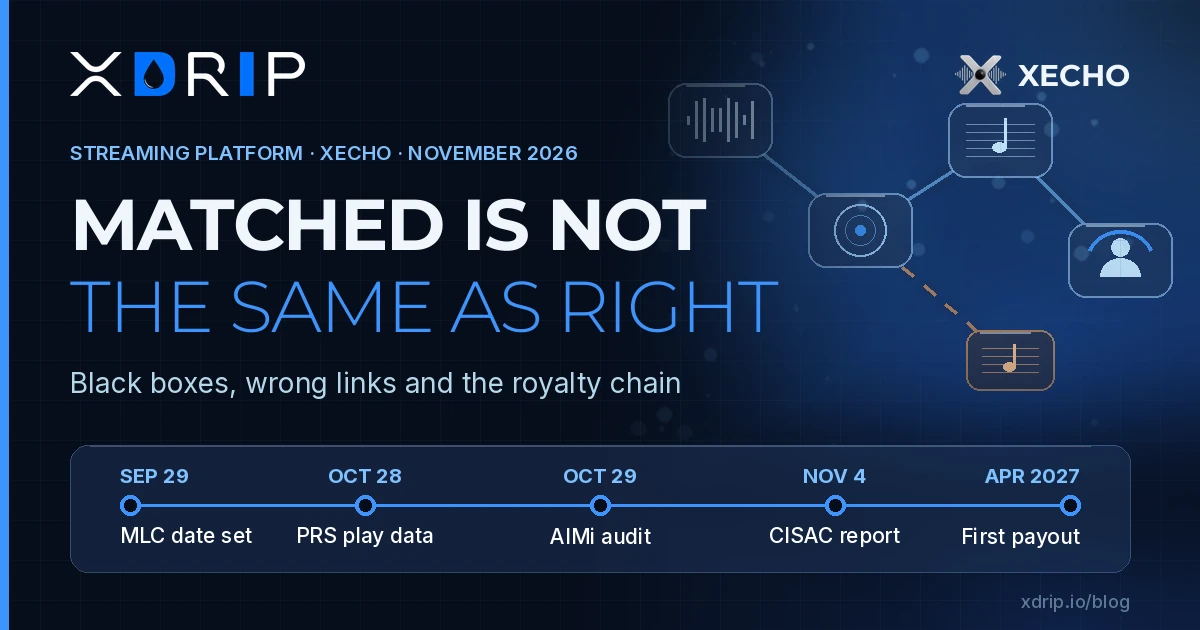
On 29 September, the Mechanical Licensing Collective (The MLC), which administers the blanket mechanical licence for streaming in the United States, announced that it has distributed more than USD 4.2 billion since January 2021. It also confirmed that, under the Music Modernization Act, it will begin market share distributions of remaining unclaimed accrued royalties in April 2027, one usage month at a time, starting with January 2021.
The mechanism is the important part. Royalties that still cannot be matched to a rights holder will be allocated on a song-based, pro rata basis: every song that earned royalties from a given service in that month receives a share of the unmatched pool. The MLC says the eligible amount for January 2021 is below USD 7 million and likely to fall further with reprocessing. Separately, Music Business Worldwide calculates that around USD 158.6 million of the historical unmatched royalties that services handed over in 2021 has still not been distributed; those funds are not part of the April 2027 start.
The process is lawful and the holding period is twice the statutory minimum. But the outcome is structural: when a work cannot be identified, its earnings follow the songs that could be identified, and the catalogues with the most matched plays receive the most.
Matched is not the same as right
The second story shows that a registration can look complete and still be wrong. On 29 October, AIMi Labs published a white paper based on public MLC data, reported by Record of the Day. It examined 111 tracks from ten best-selling albums, including Thriller, Rumours and Hotel California. Every track was registered, and recorded ownership shares averaged 99.3 percent. Yet 56 tracks were associated with more than one musical-work record that needed review.
The authors are careful to say this is a screening result, not an error rate: remixes and adaptations can legitimately carry several records. Individual cases were less ambiguous. Recordings of Fleetwood Mac's "Don't Stop" were linked to Christine McVie's composition and also to records for Queen's "Don't Stop Me Now" and Journey's "Don't Stop Believin'". AC/DC's "Hells Bells" was attached to a much earlier composition with a similar title. The study could not quantify any financial impact, because the public data does not show individual payments.
The paper's own summary is the clearest statement of the problem: being matched to a song is not the same as being matched to the right song. Ownership data can be perfect for a work and still be useless if the recording points at a different work.
Counting instead of estimating
The third story comes from the other end of the chain. On 28 October, PRS for Music announced a partnership with Soundtrack, a streaming service for businesses. PRS will receive play-by-play data, with ownership details, for around 7,000 UK premises and will use it in distributions from December 2026. Where it previously relied on sampled venues and analogous data, it will have direct usage information for these businesses.
That matters because background and live use is no longer a side income. In its 2026 Global Collections Report, published on 4 November, CISAC reported record collections of EUR 15.5 billion for 2025, with digital at EUR 6.57 billion and live and background income overtaking TV and radio for the first time. More usage is now measurable. Measured usage, though, only pays the right person if the identifiers attached to each play resolve to the right work and the right owners.
Three links in one chain
Taken together, the stories describe a chain with three links, each of which can fail on its own:
- Usage: which recording was actually played, where and how many times. PRS is replacing estimates with counts.
- Identity: which composition a recording embodies. The AIMi audit shows this link can be wrong even when everything else looks complete.
- Ownership: who holds which share of that composition and recording, and since when. The MLC black box is what remains when this link is missing.
In most of the industry, each link lives in a different private database, maintained by a different organisation, and corrected through a different claims process. A songwriter who wants to check the chain end to end usually cannot, because the data needed to do it is not in one place, and transaction-level payment data is rarely public at all.
What a shared record can and cannot do
We think a ledger is useful here for a narrow reason. A registration on a blockchain can carry a timestamped statement of who holds which rights in a work, the agreed splits, and the identifiers that link a recording to its composition. Corrections become new entries rather than silent overwrites, so the history of who claimed what, and when, stays inspectable. Payout logic in a smart contract can make the calculation repeatable: the same usage and the same splits always produce the same result.
A ledger does not fix bad input. If the wrong composition is registered against a recording, the chain records the mistake faithfully. It does not identify plays in a shop, and it does not replace collecting societies, their claims processes or the law that governs unclaimed funds. Its value is that the link between recording, work and owner, and every change to it, can be checked by the people it pays.
Where XECHO stands
XECHO is the music streaming platform we are building around fair royalties and direct artist monetization. It is in invite-only beta: access is by request, and our team reviews each request. XECHO is designed to register rights on-chain and to distribute royalties through smart contracts. In the current beta both run on testnet only; they are not live on mainnet and do not pay real royalties.
The lesson we take from these stories is a design requirement rather than a feature. An artist should be able to see, from the record itself, which recording was played, which work it was matched to, and how the share was calculated, and should be able to correct the link before money moves, not years after. We will follow the MLC's first market share distribution and the first PRS payments using Soundtrack data as they happen.
XECHO is in invite-only beta. Access is by request at xecho.pro, and our team reviews each request.