Within ten days, the music business set out three different answers to the same question: when AI turns one recording into many new versions, who gets paid, and how does anyone prove it?
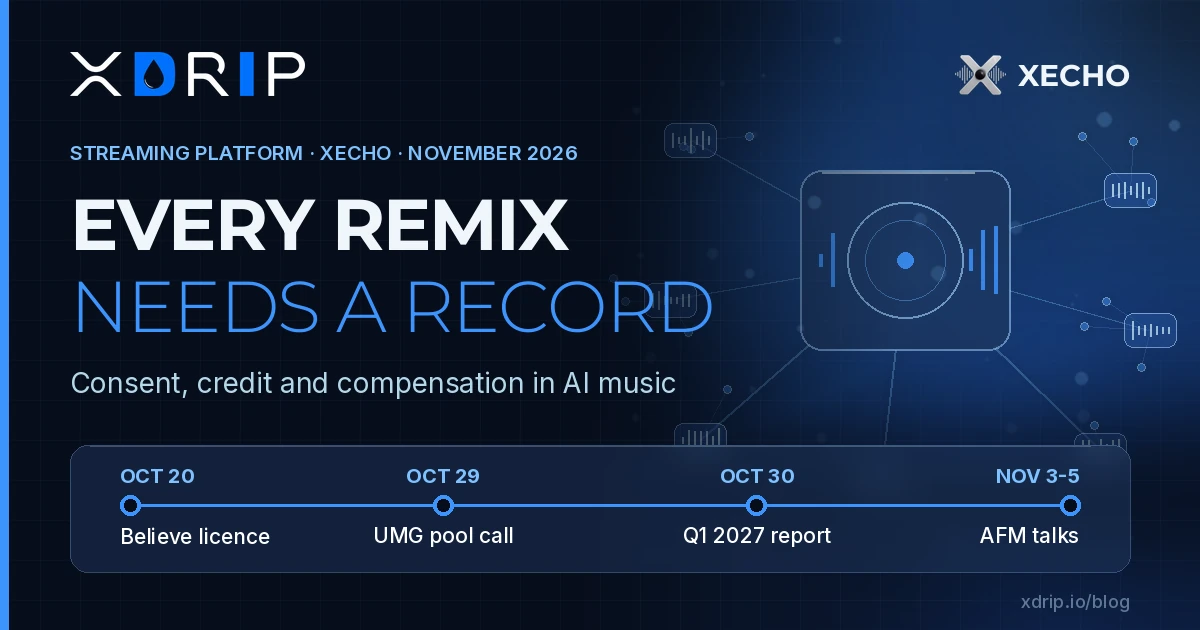
On 20 October, Spotify and Believe signed a licence for Spotify's upcoming tool for fan-made AI covers and remixes. On 29 October, Universal Music Group told investors that the way streaming services pay for music "has to change" because of fully AI-generated tracks. On 30 October, the Financial Times reported that Spotify is aiming to launch the remix tool in the first quarter of 2027. And this week, from 3 to 5 November, the American Federation of Musicians returns to the table with the major labels, with AI terms at the centre of a stalled negotiation.
Read together, these stories describe a music economy that is about to produce far more derivative versions of existing songs. Whether that is good news for the people who made the originals depends less on the AI models than on the records that sit behind them.
A licensed remix, linked to the original
Spotify's tool is designed, in the words of the Spotify and Believe announcement, "specifically for AI-powered remixes and covers, not entirely new works." Streams of those remixes are meant to generate royalties for the participating artists and rights holders behind the original songs, and "every remix on Spotify links back to the original track and artist." Participation is voluntary: Believe and TuneCore will first ask artists whether they want to be considered for AI programmes at all, and only then present the Spotify partnership to those who opted in.
According to Music Business Worldwide's summary of the FT report, Spotify is weighing a monthly add-on price of USD 4 to 5, is building a way for remix plays to be credited to the original tracks on its charts, and has so far signed deals for the tool with Universal Music Group, Merlin, Kobalt and Believe. Timing and pricing are not final, and Spotify declined to comment. Artists will reportedly decide individually whether to take part, even where their label has already licensed its catalogue.
The design choice that matters most here is the link. A remix that pays the original artist only works if the system knows, reliably and permanently, which original it came from, who holds the rights to it, and which of those rights holders agreed to this use.
The pool problem, from the other side
UMG's earnings call looked at the same economy from the opposite direction. As Music Ally reported, chief executive Sir Lucian Grainge cited Deezer's figure of more than 90,000 fully AI-generated tracks uploaded every day and said that "the uniform application of pro-rata payments makes the problem worse." His conclusion: "unethically generated AI tracks should never be compensated on the same basis as music that creates real and lasting demand."
We wrote last week about how bot streams drain a shared royalty pool. The new element is that the largest record company now wants that principle written into its platform contracts, and that streaming services are preparing to add a large, legitimate category of AI-assisted versions to the same pool. Spotify's co-CEO Gustav Söderström has described a fan remix as something that "increases the share of the streaming pool" the original artist receives. That can only be true if the platform can tell a licensed derivative of a real song apart from an unlicensed one, and both apart from a track generated from nothing.
Consent, credit, compensation
The musicians' union puts the issue in three words. In its update ahead of the November talks, the AFM says negotiations on the Sound Recording Labor Agreement have stalled over AI guardrails it summarises as consent, credit and compensation: the right to approve or refuse AI training on members' work, transparent recognition for their performances, and a direct share of revenue when catalogue recordings generate value in AI deals. The union is also pursuing a lawsuit against Universal Music Group, Warner Records and Atlantic Records over AI licensing of catalogue recordings, which the labels have asked the court to dismiss; the court has not yet decided the matter.
The three words map neatly onto three records that any AI-era royalty system has to keep:
- Consent is a record of who agreed to what, for which use, and when. An opt-in that lives only in an email thread or a label's internal spreadsheet is hard for anyone else to check.
- Credit is a record of lineage: which original a version derives from, and which performers, writers and producers contributed to that original. A link in an app is a start; a link that survives across platforms and years is the real requirement.
- Compensation is a record of calculation: which plays were counted, how the split was applied, and where the money went.
None of this is exotic. Each of the stories above depends on it. What is still missing in most of the industry is a shared, verifiable place where those records live, rather than a set of private databases that each party has to take on trust.
What a ledger is good for here
We think on-chain records have a specific, limited role in this picture. A registration on a blockchain can carry a timestamped claim of who holds which rights in a work, the split those rights holders agreed, and the terms under which derivatives are allowed. A derivative can then point to that registration, so the lineage from remix to original is checkable by anyone with access to the record, not only by the platform that hosted the remix. Payout logic in a smart contract can make the calculation repeatable: the same inputs always produce the same split.
A ledger does not decide what is fair, it does not detect a bot, and it does not replace the contracts, consent processes and detection work that labels, distributors and platforms are building now. Its value is narrower: it makes the agreed terms and the resulting payments inspectable after the fact.
Where XECHO stands
XECHO is the music streaming platform we are building around fair royalties and direct artist monetization. It is in invite-only beta: access is by request, and our team reviews each request. XECHO is designed to record rights on-chain and to handle royalties through smart contracts. In the current beta, both run on testnet only; they are not live on mainnet and do not pay real royalties.
The week's news sharpens the question we want XECHO to answer well. As versions of songs multiply, an artist should be able to ask any platform three things and get an answer from the record itself: did I agree to this use, is my work credited as the source, and how was my share calculated? We will be following the AFM talks this week and the details of Spotify's launch as they become public.
XECHO is in invite-only beta. Access is by request at xecho.pro, and our team reviews each request.