When a recording contract was signed in 1985, or even in 2015, nobody wrote down whether the song could be used to train a model, or whether the singer's voice could be cloned after the deal ended. In the past two weeks that missing sentence turned up in a federal courtroom, in a leaked K-pop contract, in two new lawsuits and in a government consultation on the other side of the world. The question behind all of them is simple to ask and hard to answer: who has the authority to say yes?
For anyone who builds music services, that question matters more than any single verdict. A licence is only as good as the record that shows who granted it, for which use, and on whose behalf.
Contracts that never mentioned AI
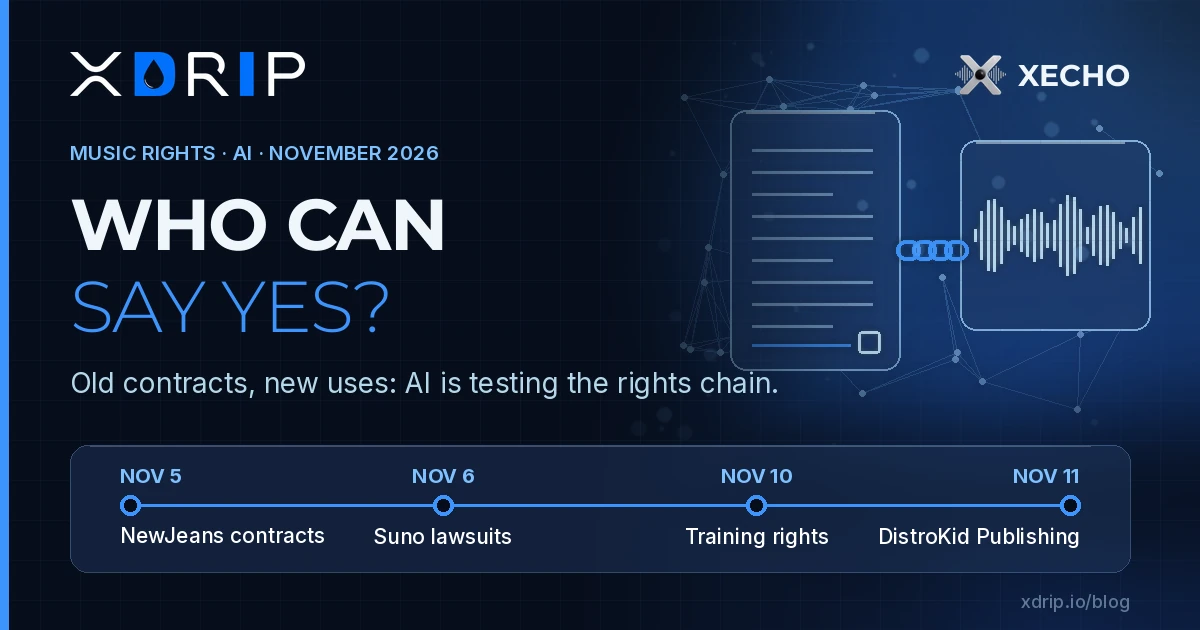
On 10 November, during a discovery conference in Universal Music Group's copyright case against Suno, the AI company's lawyers raised an argument that has rarely been made in public. As Digital Music News reported, Suno's counsel questioned whether the major labels "have the rights to license these works for AI training" at all, noting that artist agreements, some of which in Sony's case go back to the 1980s, "don't anticipate AI". Counsel for the labels replied that no determination has been made that they lack those rights. Universal and Sony are now expected to disclose which of the works at issue have been licensed to AI platforms.
Whatever the court decides, the exchange shows where the uncertainty sits. Owning a master recording and holding the right to license it for a use nobody imagined at signing are not automatically the same thing. When the contract is silent, both sides read the silence in their own favour.
A voice is not a recording
Five days earlier, on 5 November, The New York Times published the 2022 exclusive contracts of the K-pop group NewJeans, signed when the members were between 14 and 17. According to Music Business Worldwide's summary, the Times reported that the agreements allow the label, ADOR, to use and license the members' names, likenesses and voices after the contracts expire in 2029, including through AI-generated voice clones or chatbots. HYBE and ADOR responded that the contracts protect the artists' personal rights and that "the use of AI-generated content naturally requires the individual consent of each artist".
The two readings of the same document are the point. A clause that one party sees as a broad licence, the other sees as limited by consent that was never written into the same paper.
On 6 November the voice question reached a US court from a different direction. Elvis Presley's rights holders, including Elvis Presley Enterprises and Authentic Brands Group, sued Suno in the Northern District of California. The Los Angeles Times describes the complaint as one of the first major tests of Tennessee's ELVIS Act, the 2024 law that protects voice, image and likeness against unauthorized commercial use, including AI voice cloning. Suno denies the allegations and says it does not allow prompts for specific artists' names and songs.
Ownership, counted song by song
The same legal team filed a second complaint that day for Eight Mile Style, the publisher that controls 269 compositions associated with Eminem's early catalogue. Per the LA Times, it says Suno trained its model on those works without authorization and seeks about USD 41 million in damages; Eminem himself is not a party. Suno already faces suits from Round Hill Music and Reservoir, alongside the cases brought by Universal and Sony, while Warner, BMG and Believe have signed licences with it.
Read together, these cases show how fragmented the permission map is. A model can be licensed by one major, sued by two others and challenged by independent publishers over individual compositions, all for the same training data. Each claim depends on being able to prove, work by work, who controls what.
The same discipline is arriving at the independent end of the market. On 11 November DistroKid launched a publishing administration service powered by Kobalt. As Music Business Worldwide reported, only original songs qualify, including co-writes where the writer owns just a share; covers, remixes, mash-ups and fully AI-generated tracks do not. To collect, a songwriter has to state what they wrote and what share they hold.
Opt-in, opt-out, or no choice at all
Governments are being asked to settle the question by default. On 8 November IFPI chief executive Victoria Oakley told Guardian Australia that weakening Australian copyright law for AI training would be "a disaster for creativity", as the government weighs requests from AI companies, including a proposed opt-out model under which content could be used for training unless rights holders object. The attorney general's office has said any future changes must deliver "meaningful control and fair compensation".
Opt-out and opt-in describe who has to act. Under opt-out, silence means yes. Under opt-in, silence means no. Both only work if there is a reliable place to record the answer, attached to the right work and the right person.
The money involved is not abstract. CISAC's 2026 Global Collections Report, published on 4 November, puts digital music collections for 2025 at EUR 6.41 billion, up 27.9 percent and now the largest single source of income for music creators.
What a rights record should answer
From this month's stories we take four questions that any rights record, on paper or on a ledger, should be able to answer:
- Who holds which share? Composition and recording, writer and performer, with splits that add up and names that can be contacted.
- Which uses are covered? Streaming, sync, training and voice are separate permissions. A record that lists only "all rights" will be read in whichever direction suits the reader.
- When was consent given, and can it be withdrawn? A permission without a date and a scope is an argument waiting to happen.
- How is payment reported back? If a use is licensed, the person who granted it should be able to see that it happened and what it earned.
None of these is a technical novelty. They are what contracts written before AI did not capture, and what courts are now being asked to reconstruct after the fact.
Where XECHO stands
As XDRIP Digital Management LLC, we are building XECHO, a music streaming platform centred on fair royalties and direct artist monetization. XECHO is designed to register rights on-chain, so that ownership shares and their history are recorded in one verifiable place, and to distribute royalties through smart contracts according to those shares. In the current beta both functions run on testnet only; they are not live on mainnet and do not pay real royalties.
A registry cannot decide who is right in a contract dispute. What it can do is make the answer to "who agreed to what, and when" something an artist can point to instead of something lawyers have to infer. That is the problem we are working on.
XECHO is in invite-only beta. Access is by request at xecho.pro, and our team reviews each request.
Sources
- Digital Music News, The UMG v. Suno Discovery Dispute Rages On — Now, Suno Is Questioning Whether the Majors 'Have the Rights' to License Their Catalogs for Training (10 November 2026)
- Music Business Worldwide, HYBE responds to NYT report on NewJeans contracts (6 November 2026)
- Los Angeles Times, Elvis rights holders and Eminem's publisher sue Suno, testing the ELVIS Act (9 November 2026)
- Music Business Worldwide, DistroKid launches music publishing service powered by Kobalt (11 November 2026)
- The Guardian, Weakening AI copyright law will spell 'disaster for creativity', global music body warns Albanese (8 November 2026)
- CISAC, Global creator royalties reach record EUR 15.5bn (4 November 2026)