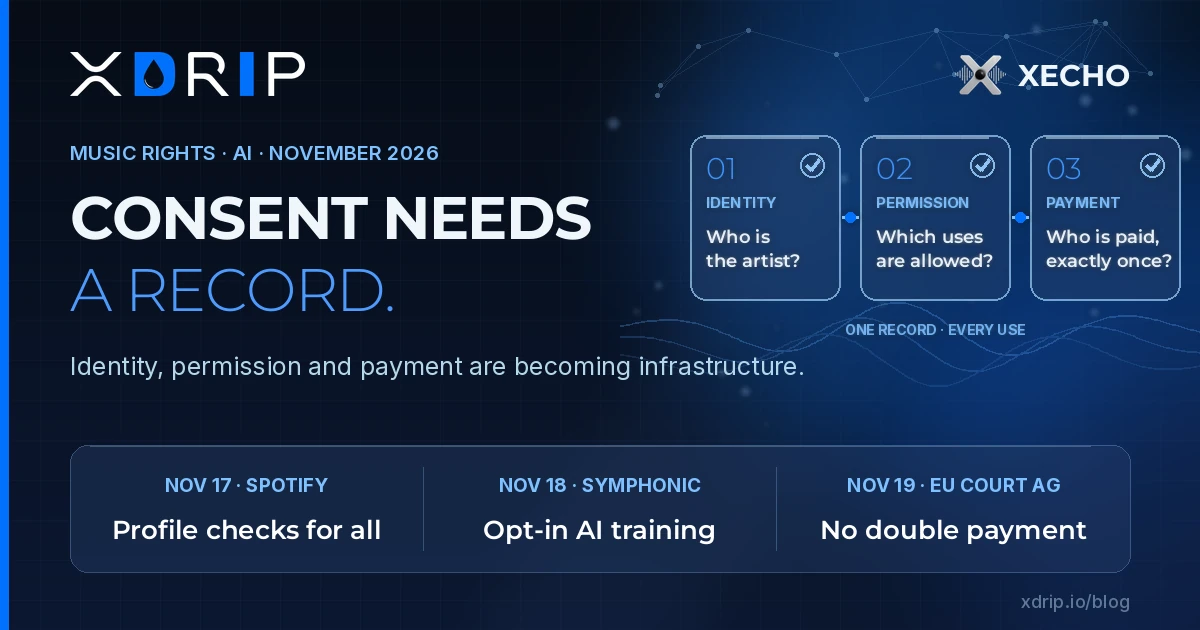
For most of the history of recorded music, an artist's consent lived in a contract, and the contract lived in a filing cabinet. Last week showed how fast that is changing. Between 17 and 20 November, Spotify opened an identity check to every artist on its service, an independent distributor let its clients opt in to AI training, Warner Music Group said it would open its AI permissions tool to the rest of the industry, Universal Music Group described opt-in conversations with thousands of artists, and an Advocate General at the EU Court of Justice set out when platforms may pay creators directly without paying twice for the same use.
None of these stories is about a single court case or a single model. Together they describe something more practical: consent is turning into infrastructure. And infrastructure, unlike a clause, has to be queried, enforced and audited by machines, many times a day.
Identity: is this release really yours?
On 17 November Spotify made Artist Profile Protection available to all artists, eight months after a beta that started in March. Once an artist team turns it on, it receives an email whenever a release is delivered with the artist's name attached, and can remove itself from releases that are not theirs. As Music Business Worldwide reported, the default "Review releases" mode lets new music go live as scheduled unless the artist intervenes, with up to 28 days after release to act. A stricter "Block releases" mode holds deliveries until the artist approves them, and trusted distributors can be given an "artist key" that marks their deliveries as pre-approved.
Two details matter for anyone building music systems. First, the default changed during the beta: in March, releases an artist ignored were blocked; now they publish. The burden of attention sits with the artist. Second, Spotify notes that a removed release may still appear under the artist's name on other services. The check is real, but it is local to one platform. The "artist key" is, in effect, a credential: whoever holds it can speak for the artist on delivery.
Permission: opt-in, one catalog at a time
On 18 November the AI audio company Sonilo and the independent distributor Symphonic announced a licensing deal that lets Sonilo train its video-to-music model on recordings from Symphonic artists and labels who choose to opt in. According to Music Business Worldwide, financial terms were not disclosed and neither company said how many clients have opted in. Sonilo says it will provide attribution reporting for the rights holders involved, building on an October partnership with Musical AI, whose technology measures the contribution of licensed recordings and compositions to each generated output.
At the other end of the market, Universal's chief digital officer Michael Nash told Morgan Stanley's European technology, media and telecom conference in Barcelona that the company is "literally conducting conversations with thousands and thousands of artists" about opting in to its generative AI products, and that it needs critical mass to launch them, as Digital Music News reported. Universal's model keeps fan-made remixes and custom songs inside a higher subscription tier rather than letting them circulate on general streaming services.
Warner's chief executive Robert Kyncl described the operational side of the same problem on the company's fiscal fourth-quarter earnings call. Per the call transcript, he said permissions for songs and for name, image, likeness and voice could not be managed "in spreadsheets", because there will be far more AI partners than there ever were user-generated content platforms. Warner's answer is Sureel, the company it acquired in June, which is built to set permissions once and syndicate them to platforms through APIs, and which Kyncl said is being opened to any participant in the music industry. Sureel's own onboarding documentation shows what that means in practice: separate choices for training and for generation, a do-not-train registry that developers can check before training, and a rule that a composition can only be opted in once 100 percent of it is cleared.
Payment: credited once, paid once
Permission without payment is only half a system. Kyncl said Suno, whose licensed model launched in September, is paying royalties to Warner and that Warner expects a material contribution in fiscal 2027, without giving figures, as MarketBeat summarized.
The legal side of payment moved in Luxembourg on 19 November. In a case brought against Belgium's 2022 copyright law by subsidiaries of Google, Spotify, Meta, Streamz, Sony Music, Universal and Warner, Advocate General Maciej Szpunar considered a right that lets authors and performers who have assigned their exclusive rights still collect remuneration directly from streaming and content-sharing services, through collective management organisations. According to the Court's press release, he found that such a right is not precluded in principle for licensed content, but that the mechanism must prevent the same exploitation from giving rise to double payment, particularly where the producer has already been paid under its licence, and must not block multi-territorial licensing. The opinion is not binding; the Court will rule later.
"Prevent double payment" sounds like a legal phrase. It is also a data requirement. A platform can only avoid paying twice for the same use if it can see, for each work and each use, who has already been paid and under which licence.
What a permission record has to do
Read together, last week's announcements describe the properties any working permission layer needs, whether it runs on a database, a standard message format or a ledger:
- Bind consent to a verified identity. Spotify's artist key shows that "who is speaking for this artist" is itself a credential, and has to be issued, held and revoked with care.
- Be granular and checkable before use. Training, generation, voice and fan remixes are separate permissions. Sureel's 100 percent clearance rule shows that a co-written song cannot be opted in by one writer alone.
- Travel across platforms. A removal on one service that does not reach the next one leaves the problem in place. Permissions set once only help if every service reads the same answer.
- Link use to payment, exactly once. Attribution reporting and the Advocate General's double-payment test point to the same need: each use should map to a known set of payees, without gaps and without duplicates.
- Keep history. Defaults change, as Spotify's did between March and November, and artists change their minds. A permission without a date is hard to defend later.
None of this is exotic. It is ordinary record-keeping, applied to more uses, more partners and more automated requests than the industry has handled before.
Where XECHO stands
As XDRIP Digital Management LLC, we are building XECHO, a music streaming platform centred on fair royalties and direct artist monetization. XECHO is designed to register rights on-chain, so that ownership shares and their history sit in one verifiable record, and to distribute royalties through smart contracts according to those shares. In the current beta, both functions run on testnet only; they are not live on mainnet and do not pay real royalties.
The stories of the past week are a reminder of why we start from the record rather than from the feature. Identity, permission and payment only work together when they point to the same source of truth about who owns what.
XECHO is in invite-only beta. Access is by request at xecho.pro, and our team reviews each request.
Sources
- Spotify for Artists, Introducing Artist Profile Protection (updated 17 November 2026)
- Music Business Worldwide, Spotify expands access to Artist Profile Protection (17 November 2026)
- Music Business Worldwide, Sonilo inks licensing deal with Symphonic to train its model on opted-in indie recordings (18 November 2026)
- Digital Music News, Universal Music Group Defends Its 'Walled Garden' AI Strategy (20 November 2026)
- Benzinga, Warner Music Group Q4 2026 Earnings Call Transcript
- MarketBeat, What Warner Music Group (WMG) Said on Its Q4 Earnings Call (19 November 2026)
- Sureel, Media Onboarding
- Court of Justice of the European Union, Press release: Opinion of Advocate General Szpunar on the Belgian remuneration law (19 November 2026)