Who owns a song is supposed to be a simple question. In practice, the answer can depend on the year the song was written, the contracts signed since, the country where it is played and the database you happen to check. Two pieces of news from 19 October 2026 show how much is still riding on getting that answer right.
A worldwide reclaim, left standing
US copyright law gives songwriters a second chance. After a set number of years (56 for works created before 1978, 35 for later ones), authors or their heirs can terminate the assignments they signed and take their rights back. For decades, the music business treated that right as covering the United States only, with publishers keeping control of the same song everywhere else.
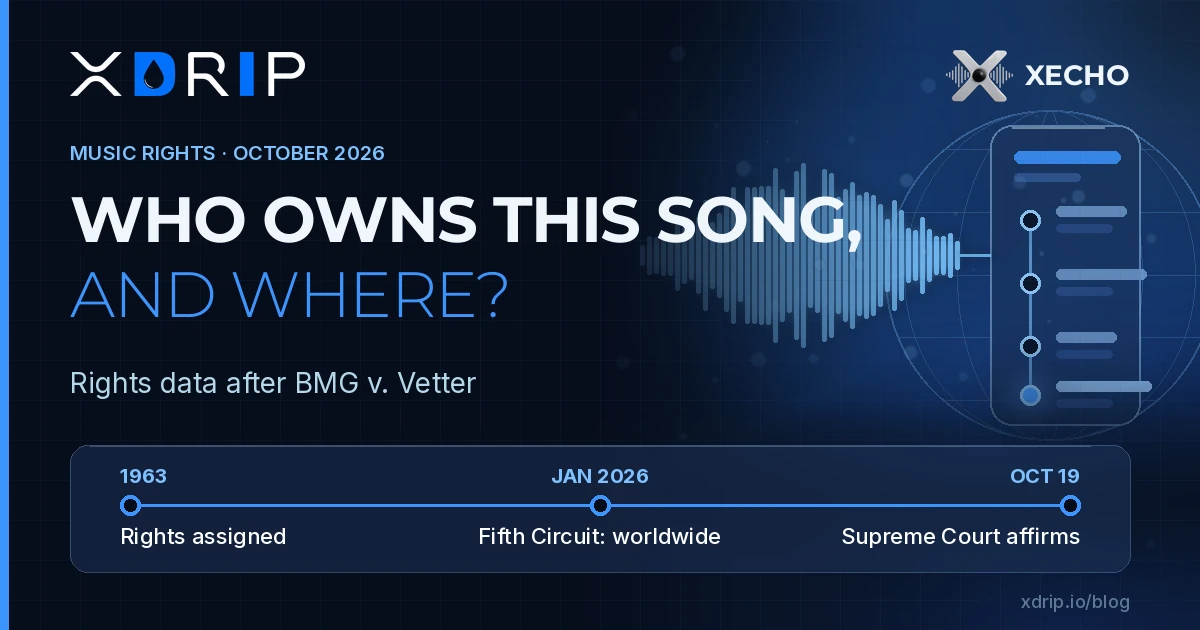
The case of "Double Shot (Of My Baby's Love)" challenged that assumption. Co-writer Cyril Vetter terminated his 1963 assignment and asked a court to confirm that he had recaptured the song worldwide. In January, the US Court of Appeals for the Fifth Circuit agreed, holding that termination under the Copyright Act returns worldwide ownership, not just domestic rights (Justia summary of Vetter v. Resnik).
BMG and the major labels asked the Supreme Court to overturn that ruling. On 19 October, the case ended without a decision on the merits: four justices took no part, the Court lacked a quorum, and under federal law the lower court's judgment was affirmed (Supreme Court docket 25-1391). As Music Business Worldwide explains, the ruling now binds federal courts in Louisiana, Mississippi and Texas, but sets no nationwide precedent, and courts, collecting societies and licensees outside the US may still apply their own laws.
For creators, the result is meaningful and messy at the same time. A songwriter may now hold a credible claim to worldwide rights in one part of the US, while records elsewhere still list the original publisher. Every licence, every royalty statement and every sync request depends on which version of the truth the other side relies on.
Rights data is becoming the battleground
The same day, Musixmatch announced its first acquisition: Music Reports, the company behind the Songdex copyright registry and the Blokur rights and licensing platform. According to Music Week, the goal is a combined metadata layer that connects recordings, compositions and rights information, covering mechanical, sync, print and performance rights.
Founder and CEO Max Ciociola summed up the problem plainly: "When no one can identify who wrote a song, who owns it, or who should be paid, creators lose." Digital Music News adds that the company frames the deal as a foundation for "agentic royalty management", with AI agents matching music use continuously while verified data and people decide what holds.
Put the two stories side by side and a pattern emerges. Ownership can change long after release, through termination, sales, inheritance or new agreements. AI is increasing the volume of music being released and used. And the systems that pay creators still rely on matching records that were often entered once, by different parties, in different formats, years ago.
What a better record looks like
We think rights information should be treated as a living record, not a one-time registration. That means three things:
- A clear origin. Who created the work, when, and who contributed to it, recorded at the moment of release.
- A visible history. Changes in ownership or splits are added as new, timestamped entries rather than overwriting the past, so anyone can see what changed and when.
- Payments that follow the record. When the rules for who gets paid are stored alongside the ownership data, royalties can follow the current state of the rights instead of a stale copy.
This is the thinking behind XECHO, our decentralized music streaming platform, currently in invite-only beta. XECHO is designed so that, when an artist publishes, the release is recorded on-chain as a DOT: a timestamped record of rights tied to that moment, not a legal title to the song. Contributors such as producers, writers and featured artists are added with their own wallets, so splits are defined before the first play, and royalties are handled through smart contracts as music is streamed.
An on-chain record does not settle legal disputes, and it does not replace copyright law, courts or collecting societies. A termination notice, a court ruling or a new agreement still decides who owns a song. What a transparent, append-only record can do is make the current state of those rights, and how it got there, visible to everyone who needs to rely on it.
What creators can do now
Whatever infrastructure you use, a few habits protect your rights:
- Keep your own copy of every agreement, including the date it was signed and the territories it covers.
- Know your termination dates. If you assigned rights in the US, check when your termination window opens and how far in advance notice must be served.
- Register splits before release, in writing, with every collaborator.
- Check the main registries where your works appear, and correct mismatches early.
- Read royalty statements by territory and source, so gaps in ownership data show up as gaps in income you can trace.
The Vetter case will not be the last time a court is asked where a songwriter's rights end. The more clearly ownership is recorded from the start, the less creators depend on others to find the right answer later.