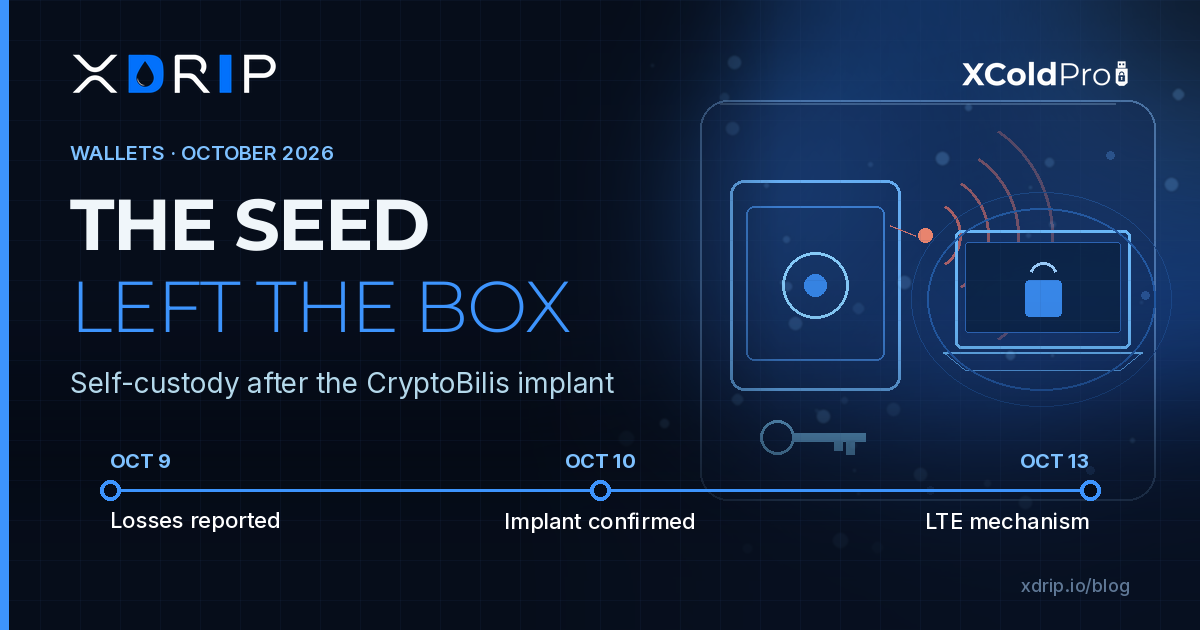
In mid-October 2026, Ledger confirmed what on-chain trackers had already counted in the tens of millions of dollars: some devices sold through Southeast Asian reseller CryptoBilis contained an unauthorized hardware implant. According to CoinDesk's report of Ledger's investigation update, the implant sat inside the device enclosure, read the 24-word recovery phrase from the screen during setup, and transmitted it over LTE using an eSIM. The Secure Element and firmware were not rewritten. Transactions were not altered. The seed left through a side channel that buyers had no practical way to see.
That detail matters for anyone who treats self-custody as a finished problem once the private key is "offline". Offline is necessary. It is not sufficient if the machine that generates and displays the seed belongs to a supply chain you cannot inspect.
What Ledger said — and what researchers counted
Ledger described the thefts as a physical supply-chain attack, not a breach of its software or internal systems. The implant did not modify the Secure Element or the operating system. It watched the screen, decoded the recovery phrase, and sent it out over a mobile network. With those words, an attacker can recreate the wallet elsewhere and move funds without ever touching the original device again.
Ledger said every confirmed loss in the October 9 disclosure involved a signer sold through CryptoBilis, and that it had not verified a drain linked to a device bought elsewhere. The company asked CryptoBilis buyers not to initialise unused devices and urged those who had already set one up to move assets to a new device with a newly generated recovery phrase. CryptoBilis stopped selling Ledger signers while the investigation continued. Decrypt and BleepingComputer carried the same core facts.
Ledger has not confirmed a total loss figure. Independent on-chain work put the scale much higher: Bitquery later counted about $102 million across more than 300 wallets on several chains, and earlier coverage cited estimates around $86–93 million with Tether freezing $10 million in USDT tied to the theft. Treat those numbers as third-party estimates unless the manufacturer confirms them. The security lesson does not depend on the exact total.
Self-custody is a chain of trust, not a sticker
"Not your keys, not your coins" is still true. CryptoBilis shows the complementary rule: whoever can observe your seed at birth owns your future balance.
A recovery phrase displayed on a screen is plaintext. If an implant, a camera, a compromised display pipeline or a malicious companion app can see it once, the sealed box and the offline promise do not help. The attacker does not need to break the Secure Element. They only need one clear view of the words.
That is why purchase channel, physical integrity and setup hygiene are part of self-custody, not optional extras. Buying through channels you cannot verify, accepting a device that arrives "pre-initialised", or typing a seed into anything online collapses the model. Ledger's own guidance after the incident — do not set up unused CryptoBilis devices; migrate with a new phrase if you already did — is the correct emergency playbook for that specific case.
Sealed devices vs a machine you control
Dedicated signing gadgets solve a real problem: they keep keys off everyday internet-connected phones and laptops. They also introduce another problem: you inherit a closed physical object, a manufacturer, a reseller network and a chain of custody you usually cannot audit end to end. When that chain is compromised, the attack looks like legitimate setup. The screen shows your words. The implant sends them. Nothing on-chain looks wrong until the funds leave.
Software-first cold storage takes a different bet. Instead of trusting a sealed product that arrived through distribution, you turn a computer you already own into an air-gapped signing environment. You choose the machine. You decide that it never reconnects to a network. You can open it, wipe it, replace the drive and verify what runs on it. There is no opaque implant inside a product you ordered from a distant reseller, because there is no product in that sense — only software and a machine under your desk.
That is the design of XColdPro, developed by XDRIP Digital Management LLC. XColdPro is cold wallet software for Windows and macOS. It is hardware-agnostic: it does not require a proprietary signer or a dedicated USB gadget. Keys stay offline, encrypted with AES-256-GCM, and signing happens on the isolated machine you configured. Editions Frost, HellBound and Nyxor cover different risk profiles, including Shamir-style recovery (SeedVault), decoy protection (BlackHole) and M-of-N multisig (Citadel).
We are not claiming that software removes every risk. A poorly isolated laptop is still a laptop. The claim is narrower and practical: reducing reliance on sealed third-party hardware reduces exposure to exactly the class of attack CryptoBilis demonstrated — physical implants in the distribution chain that leak the seed at setup.
What this month should change in your checklist
Whether you use XColdPro, another air-gapped workflow or a dedicated device from a vendor you trust, October's implant case should update how you think about "cold":
- Treat setup as the highest-risk moment. The recovery phrase is most exposed when it is first generated and displayed. Protect that moment like a cash handoff.
- Prefer channels you can verify. Direct manufacturer channels and documented chain of custody beat a bargain from an opaque reseller. If a reseller is later named in an investigation, follow the vendor's migration advice immediately.
- Never enter a recovery phrase into a website, form or "support" chat. That rule was already absolute; CryptoBilis does not soften it.
- Separate browsing from signing. The machine that opens email and dApps should not be the machine that holds long-term keys.
- Plan migration before you need it. Know how you would move to a newly generated seed on a clean environment if your current setup is compromised.
- For treasuries, add process friction. Multisig without independent review and offline signing still failed elsewhere this month when approvals were rushed. Combine isolation with policy.
The bottom line
The CryptoBilis implant did not "break cryptography". It broke an assumption: that a sealed signing device fresh from a reseller is a trustworthy place to create a seed. Self-custody survives that kind of failure only if your threat model includes supply chain and setup observation, not just malware on a hot phone.
Air-gapped signing on a computer you own will not stop every mistake. It does remove the sealed-device distribution surface that this incident exploited. If you want that model, start at xcoldpro.com. For more from us on tokenization, security and product updates, keep reading the XDRIP blog.
Figures and mechanisms above follow public reporting (CoinDesk, Decrypt, BleepingComputer, Bitquery) at the time of writing. Loss totals attributed to on-chain researchers are not Ledger-confirmed. This article is for information only and is not financial advice.