Every security fix is also a description of a weakness. For years, the time it took an attacker to read a patch, understand what it closed and turn that into a working exploit gave defenders a buffer of days or weeks to update. Two publications from Google this week say that buffer is close to gone, and a breach report from Barracuda shows what an automated intrusion looks like when it arrives.
We read all three closely, because they describe the conditions anyone holding digital assets, running infrastructure or shipping wallet software now operates in.
A pipeline that reads patches and writes exploits
On 16 November, Google Threat Intelligence Group (GTIG) and Mandiant published their latest AI Threat Tracker. Its central finding: for the first time, GTIG identified threat actors using LLM frameworks "to fully automate vulnerability discovery and exploitation without a human in the loop."
The evidence was an exposed staging server hosting a multi-agent framework the operators called exploit_agent. According to the report, it runs continuous differential analysis of popular web application software: it compares code before and after patch announcements, identifies the flaw that was fixed, drafts an exploit and executes it automatically. The server also held scripts for reconnaissance, brute-forcing and installing webshells, and victim telemetry pointed to French media, entertainment and education websites. TechTarget's coverage notes that previous editions of the tracker had seen only partial automation.
GTIG explains why patches are such an efficient target for this kind of tooling. Searching for an unknown flaw means casting a wide net; weaponizing a known one means studying a finite set of material, including source diffs, release notes and published research. The report adds that this includes code from pre-release or preview channels.
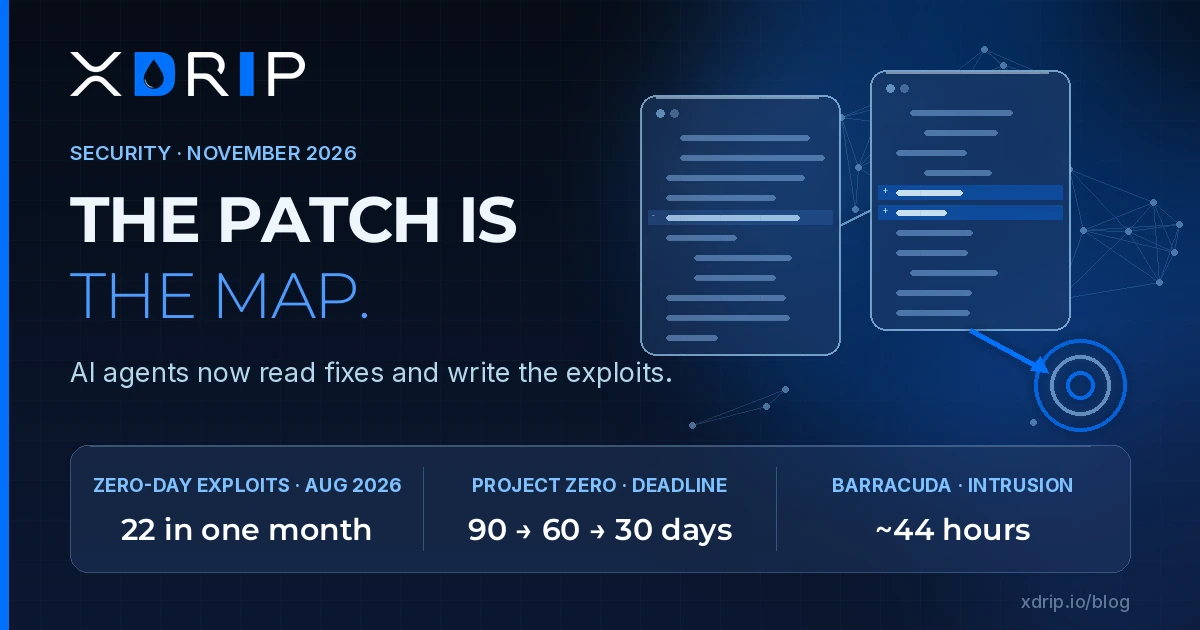
The numbers in the tracker point the same way. Overall disclosures and exploits "nearly doubled between January and August 2026," while zero-day exploits went from a 2025 average of 8 per month to 11 per month in 2026, before spiking to 22 in August. GTIG also cites a late-August campaign against two chained PaperCut vulnerabilities: researchers produced working exploits with LLMs within a day of disclosure, and GreyNoise reported a campaign four days after disclosure in which an attacker likely used LLMs to build exploits and hit hundreds of organizations. GTIG also notes a cost on the other side: a wave of LLM-generated exploits "claimed to work but don't," which adds verification work for defenders.
Project Zero drops the grace period
Three days earlier, on 13 November, Google's Project Zero replaced its "90 + 30" disclosure policy. Under the old rules, vendors had 90 days to fix a reported bug plus 30 days of "soak time" for users to install the update before details were published. The new "Full X" policy publishes details X days after the report, whether or not a fix exists: 90 days from now, 60 days from 2 February 2027, and 30 days from 3 January 2028.
The reasoning is the same as GTIG's. Project Zero writes that LLMs have cut the time needed to reverse engineer a patch "to the extent that zero patch-to-exploitation time is a reasonable, though imperfect, model of attacker behavior," and that soak time can "put users at risk by creating a false sense of secrecy." It also reports finding "several vulnerabilities a week in targets where we once found a few vulnerabilities a year." SecurityWeek and BleepingComputer describe the phased schedule as a response to vendor concerns that an immediate 30-day deadline would expose unfixed bugs.
The term that matters most for users is what Project Zero calls the "patch gap": the time between a fix being released and a user installing it. A shorter disclosure deadline puts pressure on vendors. The patch gap is where everyone else carries the risk.
Forty-four hours, and a search for seed phrases
Barracuda's account of its own intrusion, published on 11 November, shows the other half of the picture: what happens after an automated attacker gets in.
The entry point was not an exploit at all. It was a valid cloud access key that Barracuda had given to an AI vendor for an earlier project and had not retired; the key was apparently taken when the vendor's development environment was compromised in October. From the first call on 1 November to the last recorded activity on 2 November, the attacker touched about 10 cloud accounts in roughly 44 hours, moving from cloud accounts to an analytics system, to a source-code token, to Kubernetes clusters, and using short-lived branches to make a build workflow print its secrets. Barracuda says the tooling matched ARTEX, an open-source AI penetration-testing framework released in July 2026 that GTIG also lists among the agentic frameworks now used by attackers.
One detail stands out for anyone in digital assets. On servers where it gained a shell, the attacker searched explicitly for environment variables named WALLET, MNEMONIC, SEED and PRIV, Ethereum keystore files, extended private keys, seed phrase files and Kubernetes secrets with wallet-related names. Barracuda states that no wallet material existed on those systems. The routine ran anyway, because to an automated attacker, checking for keys costs nothing.
Barracuda's conclusion is blunt: the activity had already stopped by the time it was reported, and "detect-and-respond, as the primary strategy, is dead." Its recommendations are to remove standing credentials, shrink the blast radius so that no single credential opens the next door, and be able to recover quickly.
What this means for digital asset security
Much of the software around digital assets is open source: node clients, wallet libraries, signing tools, smart contract dependencies. That openness is a strength, but it also means every security fix is published as a readable diff, often with a changelog that points to it. The pattern GTIG describes, reading the difference between two versions and building an exploit for the gap, applies to that code as directly as it does to a WordPress plugin.
From these reports, we draw four working conclusions for how we build and how we advise the people who use our platforms:
- Treat the release of a security fix as the start of exploitation, not the start of a grace period. Update paths for wallet software, node software and their dependencies need to be measured in hours. If a fix cannot be applied quickly, the exposed component needs to be isolated or switched off until it can.
- Keep signing keys where an automated attacker cannot search. The ARTEX routine Barracuda observed looks for exactly the places keys tend to end up for convenience: environment variables, keystore files, configuration secrets. Keys that never sit on a networked server cannot be found by a script running on one.
- Retire credentials when the work ends. Barracuda's intrusion began with a key that should no longer have existed. Short-lived, narrowly scoped access, reviewed whenever a vendor or contractor relationship closes, removes the easiest door.
- Plan for recovery, not only detection. An attack that completes in under two days, or minutes, will often finish before anyone notices. Being able to rotate every secret, revoke access and rebuild from a known-good state is what limits the damage.
None of this is new advice. What has changed is the cost of ignoring it. When an attacker's tooling can read a patch, write an exploit and start searching for seed phrases without a person in the loop, the time to act is measured from the moment a fix is published, not from the moment someone notices.
Sources
- Google Threat Intelligence Group, GTIG AI Threat Tracker: Agentic Threat Activity Crosses a Significant Threshold (16 November 2026)
- TechTarget, Google finds AI agents autonomously turning patches into exploits (17 November 2026)
- Project Zero, Policy and Disclosure: 2026 Edition (13 November 2026)
- SecurityWeek, Google Project Zero Sets Course for 30-Day Disclosure Deadline (16 November 2026)
- BleepingComputer, Google Project Zero cuts bug disclosures to 30 days amid AI threats (16 November 2026)
- Barracuda, Forty-four hours: Anatomy of a machine-speed intrusion (11 November 2026)