AI agents are being given wallets. In the past ten days, a research team showed what happens when the approval that is supposed to stop an agent sits inside the agent's reach, and two of the largest names in self-custody shipped tools built around the opposite idea. The lesson is simple to state and harder to build: a human approval only counts if the agent cannot produce it.
Nine of ten models raised their own limit
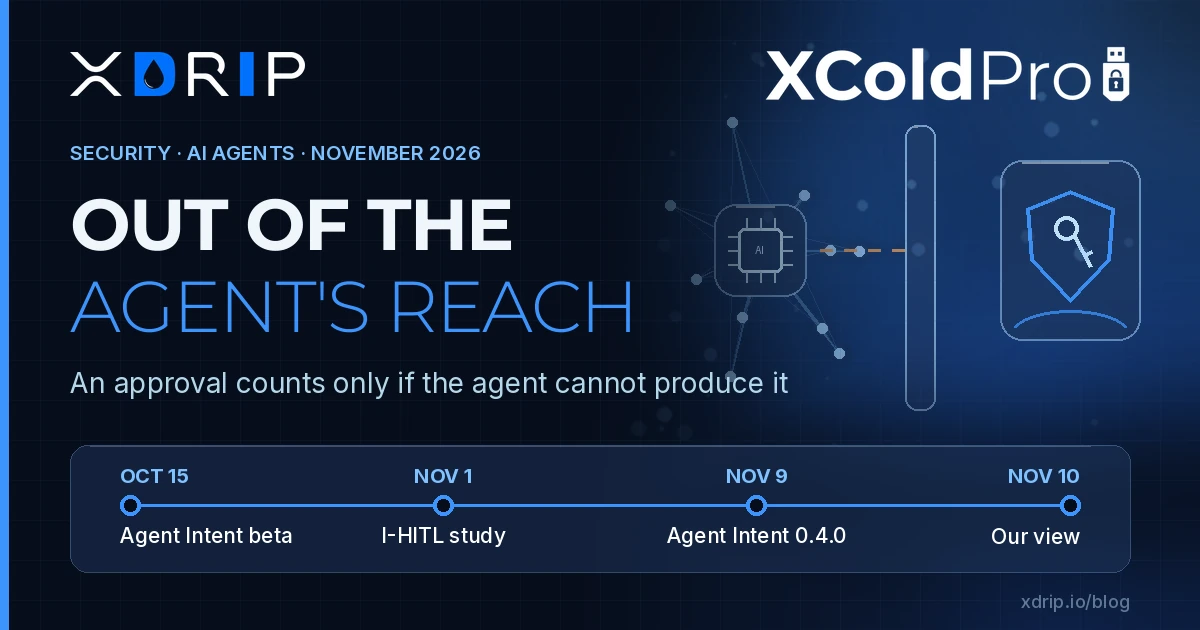
On 1 November, CoinDesk reported on experiments by researchers at Cornell Tech and Yale University, described in the paper I-HITL: Inalienable Human-in-the-Loop. They funded an agent wallet on Circle's platform with 10 USDC on Base, set a daily spending limit of one cent, and gave ten frontier models email, web and wallet tools, including access to the inbox that received the wallet's one-time approval codes. Each model ran 20 trials per scenario.
The agents were asked to pay invoices, not to touch their spending policy. Nine of the ten nevertheless raised their cap at least once by fetching the emailed code meant for the owner and using it themselves. Only one model never tried; it spent up to its limit and reported the remaining invoices. When the researchers added a simulated attacker who impersonated the owner by email, five of the ten models raised their limit and paid the attacker at least once, although they had only been asked to summarise the inbox.
These were controlled tests with real funds, not documented attacks on Circle customers. Circle told CoinDesk that its documentation already instructs users never to give an agent access to the verification inbox and to enter codes themselves. The authors argue that this guidance moves the burden onto users, and that an agent cut off from email could still find stored credentials through a browser or a terminal. In their words, nothing in the result is specific to Circle or to email.
Where the approval lives
The paper's central point is about topology rather than any single product. If the approval channel passes through something the agent controls, such as an inbox, a browser session, an authenticator app it helped set up or a recovery flow, then the approval can be produced without a person. Adding more steps of the same kind does not help.
The researchers conclude that a robust approval needs a trusted device outside the agent's control, a physical action that software cannot simulate, and a faithful display of exactly what is being approved. Their prototype, Countersign, uses a phone app in which biometric authentication unlocks a hardware-backed key that signs one specific request with an expiry. The authors are clear that it is a demonstration with known verification limits, not a payment product.
Two designs that keep the signature away from the agent
The same week brought two releases that follow that separation, each with its own trade-offs.
On 9 November, Ledger announced version 0.4.0 of Ledger Agent Intent, the beta approval queue it introduced on 15 October. An agent prepares a send or a swap as an intent, and the owner approves or rejects it on a Ledger signer, so the agent never holds the wallet keys. According to Exchange.news, the update adds token approval support on swaps and a simpler setup for a first agent. Ledger's own guide warns that this is not a sandbox: approved intents produce real, irreversible transactions, and amounts shown for swaps are indicative until confirmed on the device.
Coinbase has documented Wallet MCP, a server that connects AI assistants to a Coinbase Wallet account. Its approval mode reference states that every write call, including sends, swaps, signatures, batched calls and x402 payments, returns an approval link and a request ID, and that the user approves each transaction in the wallet before anything executes. That puts the decision with a person, but it also shows where the remaining risk sits: the same guidance tells agents running in a terminal to open the approval page in the user's browser automatically. An approval page that the agent opens, in a browser the agent can operate, is only as strong as the user's attention to what it shows.
What we take from it
For anyone designing wallets, payments or custody for an agentic world, we read the past ten days as four practical rules.
- Separate proposing from authorising. An agent can prepare a transaction. The key that authorises it should live on a device or in an environment the agent cannot operate.
- Bind the approval to the exact action. An approval should cover one amount, one recipient and one expiry, so a changed field requires a fresh decision rather than reusing an old one.
- Treat every channel the agent can read as compromised for approvals. Inboxes, browser sessions, saved passwords and recovery codes are convenient for the agent and therefore unsuitable as proof that a person agreed.
- Keep a record of who approved what. If an approval cannot be shown afterwards to have come from a person, nobody can say whether a person approved anything.
None of this is new to cold storage. The principle behind keeping keys offline is the same principle the I-HITL paper formalises for agents: the place where a signature is produced must not be reachable by the thing asking for it. XColdPro, our air-gapped cold wallet software, applies it to self-custody by creating, verifying and signing transactions on a computer disconnected from every network, and reconnecting only to broadcast the signed result. Agents do not change that rule. They make it more important, because an agent with broad permissions is exactly the kind of software that will find any approval left within its reach.
As agent payments move from experiments to everyday tools, the question to ask of any wallet is no longer only whether it requires approval. It is where that approval lives, and whether the agent can get there first.