Every time a song plays on a streaming service, two kinds of rights are being used: the recording, usually controlled by a label or distributor, and the composition, owned by songwriters and their publishers. In the United States, the price of the second one is not set by the market. It is set by three judges at the Copyright Royalty Board (CRB), every five years.
That process is happening right now. In early October 2026, the major streaming services, music publishers and a coalition of independent creators filed their opening proposals in Phonorecords V, the proceeding that will fix US mechanical royalty rates for on-demand streaming from 2028 to 2032. The filings say a lot about how royalties are calculated today, why so many creators struggle to understand their statements, and where the industry still has room to improve.
What Phonorecords V decides
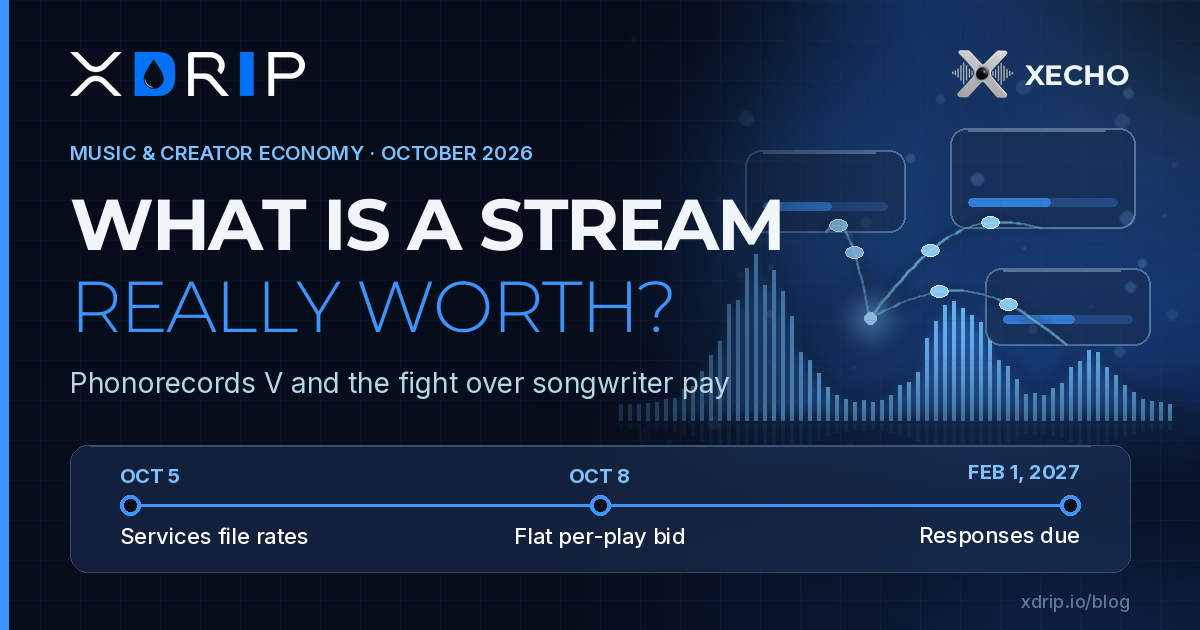
Mechanical royalties are what streaming services pay for the right to reproduce a musical work. Under US law, any publisher without a direct deal is covered by a compulsory licence, and the CRB sets its rates and terms. According to Music Business Worldwide's breakdown of the public filings, the services filed their proposals on 5 October, with redacted public versions following on 7 October.
The current framework comes from the Phonorecords IV settlement, accepted by the CRB in December 2022. Its headline rate is 15.3% of service revenue this year, rising to 15.35% in 2027. That headline figure is "all-in": services subtract what they pay for performance rights, and what remains is the mechanical royalty. For standard paid subscriptions there are also alternative calculations based on what services pay record labels, plus per-subscriber minimums.
What each side is asking for
The positions, as reported by MBW, are far apart:
- Spotify, Apple, Google and Pandora want the 2027 terms, including the 15.35% headline rate, to stay in place for the full 2028–2032 period.
- Amazon proposes cutting the headline rate to 13.4%, and wants to drop the revenue-based calculation for bundles altogether.
- The National Music Publishers' Association (NMPA) and the Nashville Songwriters Association International (NSAI) want services to pay the greatest of 20% of revenue, 40% of what they pay labels, $2.40 per subscriber per month, or $0.004 per play.
A third group took a different route. A coalition including the Songwriters Guild of America, the Society of Composers & Lyricists and Music Creators North America asked the CRB to replace the multi-step formula with a flat rate of $0.0030 per play for interactive streams, applied across all tiers, including free ones, and adjusted for inflation, as described in the SCL's summary of the filing published on 8 October. The proposal also includes a "2027 floor", so that no service could pay a lower effective per-play rate than it paid in 2027.
Bundles: the issue behind the numbers
The single most contested topic is bundling. In March 2024, Spotify reclassified its US Premium tiers as bundles that include audiobooks, which reduced the mechanical royalties it pays. Amazon introduced a similar music-and-audiobook bundle in November 2024. The Mechanical Licensing Collective (MLC) sued Spotify over the change; according to MBW, the original claims were dismissed in January 2025, the case was reopened that March, and it is still ongoing.
The stakes are large. The publishers' filing says Spotify has taken "more than $500 million in mechanical royalties that should have been paid to songwriters and publishers". Spotify's own quarterly filing, as quoted by MBW, puts its potential liability from March 2024 to June 2026 at approximately €473 million if the MLC were entirely successful, partially offset by direct deals with publishers.
Spotify's position, as Digital Music News reported on 14 October, is that the bundle terms were "a known, core term" of a heavily negotiated settlement, and that the Phonorecords IV deal should continue unchanged. Apple argues similarly that a reduced bundle rate was essential to the increases it accepted in 2022.
We are not taking sides on the legal question. What stands out to us is simpler: a reclassification of a product tier can change what thousands of songwriters earn, without any change in how often their songs are played. For most creators, that kind of shift is almost impossible to see from a royalty statement.
Why creators find royalties so hard to read
The filings also expose how many layers sit between a play and a payment.
Spotify, for example, explains in its royalties guide that it does not pay a fixed per-stream rate. Roughly two-thirds of its music revenue is allocated to recording and publishing royalties, and that pool is divided by streamshare, an artist's share of total streams in a given market and month. The money then moves through labels, distributors, publishers and collecting societies before it reaches the artist or songwriter, each under its own agreement. Since April 2024, a track also needs at least 1,000 streams in the previous 12 months to be included in the recorded-music royalty pool.
Other details in the filings add more variables:
- Google proposes a new "allocation" rule, paying statutory rates only on the share of plays that the licence actually covers. YouTube says that of six content categories on its services, only "Static-Image Art Tracks" qualify.
- Pandora asks for, among other changes, fake-stream accounts to be excluded from royalty calculations and app-store fees to be removed from the revenue base, according to Digital Music News.
None of these positions is unreasonable on its own. Together, they show how many decisions, made far from the artist, determine the final number.
Collective societies are paying out, too
Outside the US, the royalty calendar continues. PRS for Music announced that it would pay £240 million to more than 93,000 members on 15 October, including over 6,000 first-time earners, with £31 million coming from UK video-on-demand services. In Germany, GEMA is distributing €180.5 million as of 1 October across its online, international and cultural-subsidy categories.
These distributions matter, and collecting societies do essential work. But they also confirm the rhythm most creators live with: usage happens today, and the money arrives months later, after several rounds of reporting and matching.
What better infrastructure could look like
Phonorecords V will decide a rate. It will not, by itself, make royalties easier to follow. That depends on infrastructure: how ownership is recorded, how splits are defined, and how quickly and visibly payments move.
This is the problem we are working on with XECHO, our decentralized music streaming platform, now live for artists. Instead of resolving ownership and splits after the fact, XECHO records them at the moment of release:
- Ownership on record. When an artist publishes, the music is minted as a Digital Ownership Token, creating an on-chain proof of ownership.
- Splits defined upfront. Producers, writers and featured artists can be added as contributors, each with a linked wallet, so royalty splits are configured before the first play rather than reconstructed later.
- Payments through smart contracts. Royalties are distributed by smart contracts when music is streamed, instead of waiting for a quarterly statement.
- Visibility. Artists follow streams, audience and revenue in real time through the Pro Dashboard.
The details are documented on our XECHO knowledge page. XECHO does not replace copyright law, statutory licences or the work of collecting societies. What it shows is that the questions at the centre of Phonorecords V — who owns what, who gets which share, and when they get paid — can be answered transparently and close to the moment a song is played.
What to watch next
Under the CRB's revised schedule issued on 2 October, the parties must respond to each other's cases by 1 February 2027, with a settlement window from 25 January to 15 February 2027, according to MBW. The last proceeding ended in a settlement about ten months after opening proposals, so a negotiated outcome is possible again.
For songwriters and independent artists, the practical advice is the same whatever the result:
- Know which rights you own and who administers each of them.
- Document splits in writing with every collaborator, before release.
- Read your statements by source, so changes such as bundling or eligibility thresholds become visible.
- Follow the proceeding, because the rates set in 2027 will shape streaming income until 2032.
Whatever number the CRB lands on, the deeper question remains: creators deserve to see clearly what their music earns, and why. That is the standard we are building toward.