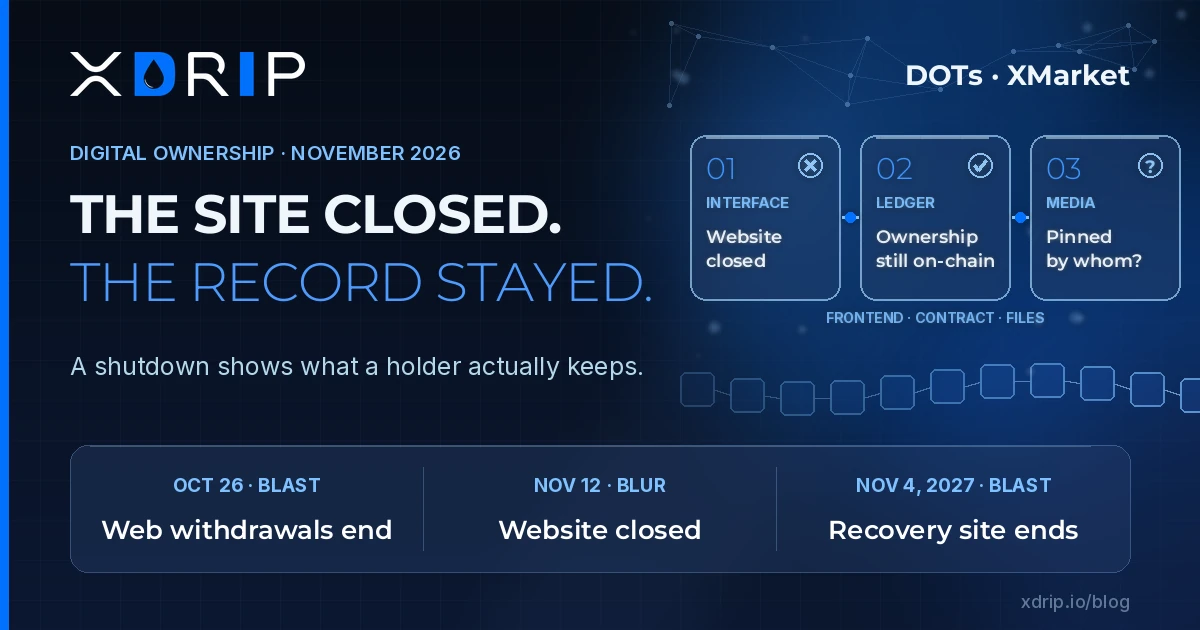
On 12 November the Blur website closed. In early 2023 Blur was the largest marketplace for Ethereum NFTs; today its address shows a single page for collecting what users still have there. A month earlier the Ethereum layer 2 network Blast announced it was winding down, and in April the curated art marketplace Foundation shut its infrastructure after a failed sale. These are business stories, but they also run a useful test: when the company behind a digital ownership product stops operating, what does the owner actually still hold?
The short answer from all three cases is that the ownership entry on a public chain survives, and almost everything around it depends on someone continuing to pay for it.
What closed and what kept running
Blur announced on 12 October that its frontend would be deprecated on 12 November 2026 and that its lending product, Blend, would stop matching new loans on the same date. The replacement page at blur.io now states it plainly: the website has closed, the marketplace protocol keeps running on-chain, and "pre-existing NFT bids and listings made on this website have been canceled." Users can connect the wallet they used to withdraw ETH from their Blur Pool balance and to repay or close open Blend loans. The page stays online until 12 November 2027.
The most instructive line on that page is this one: "Your Blur Pool balance and loans are on Ethereum, not on this page, so they won't disappear when it goes offline. Collecting them will just be less convenient." The assets are safe in the sense that they are recorded on Ethereum. Reaching them without the interface means interacting with the contracts directly.
The commercial background is in CoinDesk's report: Blur handled more than 70% of Ethereum NFT trading volume in March 2023, about $1.43 billion that month, and less than $7 million a month by March 2026, according to DefiLlama data. The wider market has not recovered either. CryptoSlam data reported by TokenPost put weekly NFT sales across chains at $29.23 million in the week to 24 November, down 12% on the previous week.
When the chain itself is the thing that closes
Blast is a harder case, because the network that held users' balances is the part being retired. On 2 October the project said that the costs of operating the chain exceed the revenue it generates and asked users to move assets back to Ethereum mainnet. Withdrawals through the normal interface ran until 26 October. When that interface expired, about $40.4 million was still in the bridge; from then on, users had to call the bridge contract on Ethereum directly, submit a proof and wait a day. Blast L2 has since been shut down, and a recovery website for remaining ETH and USD balances in L2 wallets, pending withdrawals and Blast Mobile stays available until 4 November 2027.
The pattern is the same as Blur's, one level down. Settlement on Ethereum means a path out exists after the operator leaves. But that path has a deadline for the convenient version, a technical procedure for the inconvenient one, and a meaningful amount of value that had not moved by the first cut-off.
Media and metadata are a separate dependency
Foundation's wind-down in April shows the third layer. Founder Kayvon Tehranian wrote that the infrastructure had already been spun down and could not be brought back. NFTs minted on Foundation remain on-chain and under collector control, and the team said it would keep pinning the IPFS media and metadata for one year, recommending that artists and collectors back up what they value. For NFTs still listed inside Foundation's marketplace contract, the team said it was building a separate unlisting and retrieval tool. As Tehranian put it, "while the contract is non-custodial, our frontend was the primary interface for interacting with it."
An NFT token usually holds an identifier and a pointer. The image, the description and the attributes live elsewhere, at an IPFS content address or an ordinary web URL. A content address guarantees that the file, if found, is the right file. It does not guarantee that anyone is still storing it. Once the original pinning stops, the media survives only if the collector, the artist or a third party has kept a copy.
Four layers, four different failure modes
Taken together, the three shutdowns separate a digital collectible into layers that fail independently:
- The ownership entry. The record that a given address holds a given token. On a public chain that keeps running, this is the most durable part, and none of the three closures removed it.
- Contract state the operator mediated. Listings, bids, escrow, loans and pool balances. These sit in contracts that keep working, but they were operated through one interface. Blur cancelled its website listings; Foundation needed a dedicated tool to return listed items; Blend borrowers faced loans that can still be called, with a repayment window that Blur describes as usually about 30 hours.
- Media and metadata. Files referenced by the token. Their availability depends on who stores them and for how long, and that is usually a commercial decision, not a protocol guarantee.
- The network. On a rollup or sidechain, the chain itself has an operator. When it shuts down, the exit runs through a bridge, with its own deadlines and procedures.
The practical checklist follows from that split. Collectors should know which chain holds each token, which contract it lives in, where its media is stored, and whether anything is currently listed, escrowed or lent through an interface they do not control. Holding a local copy of the media and metadata for items that matter is cheap compared with losing them. Issuers should publish the same information up front: contract addresses, where the media is stored and who pays to keep it there, and how a holder can act without the issuer's website.
How we approach this
Our DOTs are commemorative digital collectibles: collectible and utility records for provenance, access and project-specific documentation. That definition matters here, because a collectible record is only useful if it outlives the page that displays it. The questions above are the ones we apply to our own collections: where the record lives, where the files it references are stored, and what a holder can still verify and do without our interface.
XMarket, our planned collector marketplace for XDRIP collectibles, is in early pre-alpha development and no marketplace is live yet. The direction published on the XMarket page is that collection records, edition details and published perks sit next to every listing, and that transfers, where available, follow each collection's own published rules. A marketplace built on that basis should be a window onto records that exist independently of it, not the only place they can be read. More on the records themselves is on the DOTs page.
Our view
The NFT market's contraction is now removing the services people used to reach their assets, one interface at a time. The part of the promise that held is the ledger entry. The parts that did not hold were never on the ledger in the first place: the order book, the lending desk, the file hosting and, for some, the network itself. Digital ownership is only as durable as its least durable dependency, and the useful work for anyone issuing or holding these records is to know what those dependencies are before a shutdown notice makes the list for them.
Sources
- Blur, The blur.io website has closed (official notice, accessed 26 November 2026)
- CoinDesk, Once-largest Ethereum NFT marketplace Blur is shutting down after volumes collapse 99% (13 October 2026)
- KriptoMeta, Blur website closes; withdrawal page stays open for a year (14 November 2026)
- The Block, Paradigm-backed Layer 2 Blast to wind down network as costs exceed revenue (2 October 2026)
- TokenPost, Blast withdrawal interface expires with $40.4 million still in bridge (26 October 2026)
- TokenPost, Blast shuts down its L2, sets Nov. 4, 2027, asset recovery deadline (5 November 2026)
- ARTnews, Foundation NFT platform shuts down after failed Blackdove sale (16 April 2026)
- Bitcoin.com News, Digital art NFT marketplace Foundation closes after failed acquisition (17 April 2026)
- TokenPost, Weekly NFT sales fall 12% to $29.23 million (24 November 2026)
- XDRIP, XMarket and DOTs