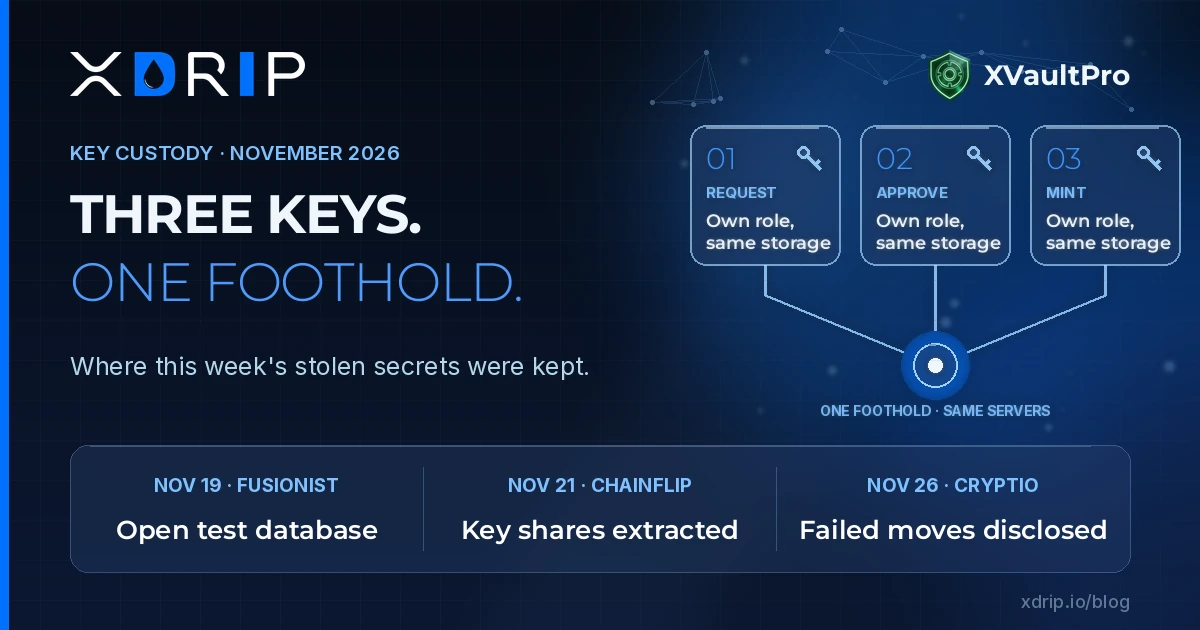
Three separate incidents this week had the same shape. In each one, the cryptography did its job and the signatures were valid. What failed was the place where the secrets were kept. On 21 November an attacker drained Chainflip's Bitcoin and Ethereum vaults with key shares taken from validator machines. On 22 November a game studio's bridge minted tokens nobody had paid for, signed by all three of its usual keys. On 26 November an accounting platform confirmed that someone had used credentials stored on it to try to move customers' assets.
None of these was a broken algorithm. Each was a question of where the secrets sat, who could reach those machines, and how many separate locks an attacker actually had to open.
100 of 150, reached through one shared library
Chainflip's vaults are built so that no small group can move funds. According to its protocol documentation, vault keys are controlled by the validator Authority Set in a 100-of-150 threshold signature scheme (FROST), and each validator holds shares rather than a whole key.
The team's first incident report, published on 23 November, describes how that design was bypassed. The attacker registered a validator account with the minimum stake. It never joined the active set, but registration alone was enough for validators to accept peer-to-peer connections from it. Chainflip says the attacker used that access to exploit a memory-safety flaw in a third-party networking library used by the validator software, ran code on validator machines and extracted the key shares stored there. With enough shares, the attacker could sign vault transactions outside the network. The team stresses that the investigation is continuing and that some steps are not yet fully confirmed.
The result: 133.34 BTC from the Bitcoin vault and 520.22 ETH, about 3.25 million USDC and 758,141 USDT from the Ethereum vault, roughly $12.6 million at prices that morning and, in Chainflip's words, effectively the entire vault balance. The timeline shows two more details worth noting. An automated warning about the Bitcoin vault fired eight minutes after the first withdrawal, but that monitor was still being evaluated and was not yet connected to automated escalation. A forced key rotation completed at 08:21 UTC, about one hour and forty minutes after the first theft.
A threshold scheme protects against a minority of dishonest or offline signers. It does not protect against a flaw that every signer shares. When a hundred machines run the same software and accept the same kind of connection, one exploit can reach all of them, and the threshold stops counting as a hundred locks.
Three role keys that lived in one place
The second case is smaller in money, but it makes the same point in plainer form. The bridge that carries Fusionist's ACE token between its own Endurance chain and BNB Chain trusts three keys: one requests each mint, one approves it and one executes it. As Bitquery's investigation puts it, three keys should mean three locks, "as long as the keys live apart."
They did not. On 22 November all three keys signed 59 fake mints, the same keys that had signed more than 3,300 genuine ones since 2023. The thieves sold about $1.73 million of ACE on decentralized exchanges, and traders then sent the crashed tokens back across the bridge, which released 53.7 million real ACE and left 148 ACE of backing. Fusionist revoked all three mint roles at 09:59 UTC on 23 November, about 16 hours after the first fake mint.
The route in, according to the timeline Fusionist's CTO shared with Bitquery and summarized by MABOnChain, started three days earlier and nowhere near the bridge. On 19 November the attacker reached a PostgreSQL database that was open to the internet in a container on a test server. On 20 November they broke out of the container and planted a backdoor. From there they took logins for the company's code-hosting platform, planted short scripts in more than 30 repositories to copy secrets held by deployment pipelines, and used those logins to reach the bridge servers. Bitquery notes the limit of what anyone outside can confirm: the chain proves which keys signed, while the path to them comes from Fusionist's own account.
The on-chain roles were cleanly separated. The off-chain storage was not. A test database, a build pipeline and a signing server sat close enough together that one foothold led to all of them.
A vendor that held other people's keys
On 26 November Cryptio, a non-custodial crypto accounting platform, told crypto.news that an external party had used what it called "frontier AI tools" to gain access to its platform, and had "attempted to move digital assets with some of those credentials." To its knowledge all identified attempts failed and no loss of assets has been found. Cryptio took the platform offline, worked with exchanges and custodians to revoke affected credentials, and asked customers to revoke every API key they had shared with it at the source, including read-only ones.
Cryptio says its accounting connections are designed to use read-only APIs, and its notice warned that customers who had connected write-enabled keys could have funds at risk. We wrote about the same pattern after Binance cut SignalPlus keys earlier this month: a service that stores many customers' keys becomes a vault in its own right, and the scope each customer gave a key decides what an intruder can do with it.
The same day, CoinDesk reported that Zodia Custody had detected attempts to probe its platform on 23 November, temporarily took its B2B API offline, and the next day found unauthorized access to information about some clients and employees, including company details, business contact names and email addresses. Zodia says there were no unauthorized transactions. Exposed names and email addresses are still useful to attackers, because they make the next phishing message more convincing.
What we take from this week
The four cases come from very different businesses: a cross-chain swap network, a game studio, an accounting tool and a bank-owned custodian. The questions they raise are the same, and we apply them to our own work.
- Map where every secret physically lives. A key's role on-chain says nothing about which machine, pipeline or account can read it. Write down the actual location of each key, share and token, and who can log in there.
- Separate keys by machine and by operator, not only by role. Three keys on one server, or behind one set of pipeline credentials, are one key with extra steps.
- Keep test systems away from production secrets. Fusionist's path began on a test server. Test and staging environments should hold no credential that can reach production.
- Treat build pipelines as signing infrastructure. If a pipeline can read a secret, anyone who can change the pipeline can read it too. Short-lived, narrowly scoped credentials limit what a stolen one is worth.
- Ask who can connect before they are trusted. Chainflip's signers accepted connections from an account that had only registered. Network exposure of signing machines is part of the key design.
- Grant the smallest scope that works. A read-only key held by a vendor limits what an intruder can do with it; a write-enabled one is a way to move funds.
- Wire alerts to people, and rehearse rotation. A warning that nobody is paged for arrives too late, and a rotation that has never been practised takes longer than it should.
Where XVaultPro fits
XVaultPro, our encrypted credential vault, is in active development, and this week is a good illustration of the problems we are designing it around. It keeps passwords, API keys, SSH keys, tokens and recovery codes encrypted offline on the user's own hardware, with no cloud sync and no browser extension. Secrets carry environment tags (Production, Staging, Development, Test) with expiry tracking and rotation warnings, so it is visible which credential belongs where and how old it is. For automation and AI agents, the design starts from "no AI access by default": scoped machine identities with time limits and retrieval caps, human approval gates for sensitive entries, and an audit record of every retrieval.
A credential vault does not secure a bridge's signing servers or a validator's networking stack, and we do not claim it would. What it can do is make the first questions on the list above easier to answer: where each secret is, which environment it belongs to, who or what can retrieve it, and when it was last rotated. This week showed how much depends on those answers.
Sources
- Chainflip, Incident Report: Bitcoin and Ethereum Vault Exploit (Part 1) (23 November 2026)
- Chainflip Docs, Protocol Overview
- Bitquery, Fusionist ACE hack: one thief held all three keys, and the backing fell to 148 coins (updated 26 November 2026)
- MABOnChain, Fusionist traces $5.7M ACE bridge hack to an open test-server database (26 November 2026)
- crypto.news, Cryptio says attacker used AI tools and tried to move crypto (26 November 2026)
- CoinDesk, Standard Chartered's Zodia Custody suffers data breach, exposing client information (26 November 2026)
- XDRIP, XVaultPro