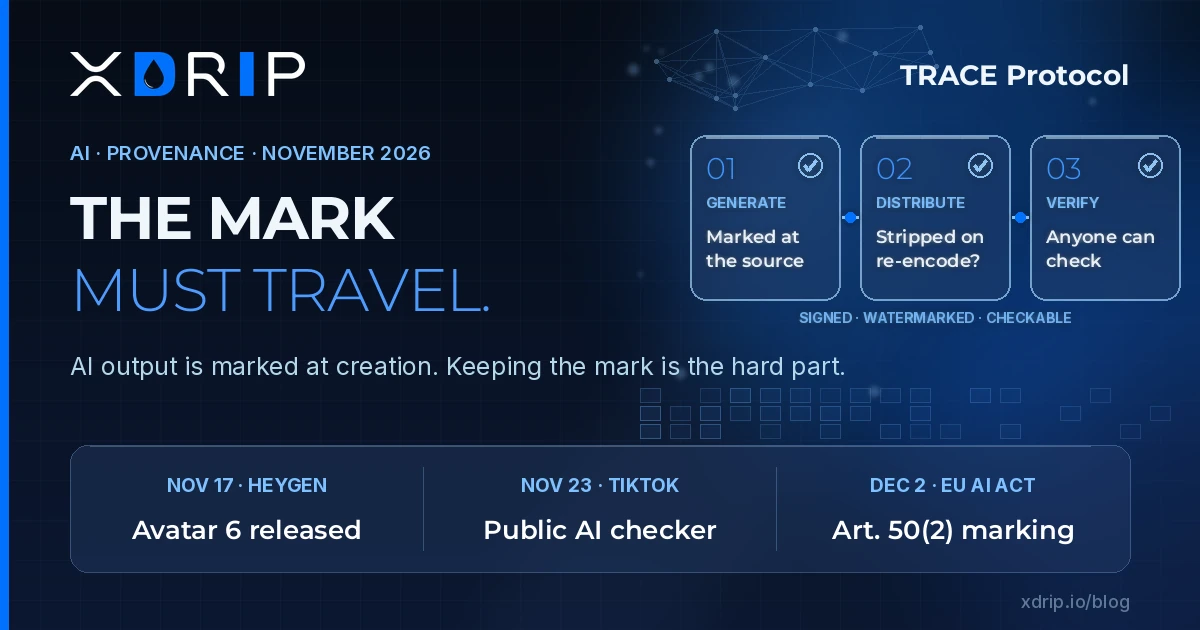
In one week, the main building blocks of AI provenance all moved. On 17 November HeyGen released Avatar 6, an avatar model that in the company's own testing 84% of participants rated as realistic as the person it represents. On 23 November TikTok opened a public checker that tells anyone whether an image or video was made with its AI tools, and began a global rollout of a tool that lets creators find AI videos using their face. On 24 November Gary Vaynerchuk launched a social channel fronted by his HeyGen avatar, answering one question a day in the asker's language. And on 2 December, the last grace period for machine-readable marking of AI output under the EU AI Act runs out.
Taken together, these stories point to one practical problem. Marking content at the moment it is generated is now routine. Keeping that mark attached and readable as the file is downloaded, edited, re-encoded and posted somewhere else is the hard part.
Two layers, because one gets stripped
TikTok's announcement is direct about the limits of metadata. Since 2024 the platform has added C2PA Content Credentials to AI content made with its tools, so that other platforms can read and label it. But, in TikTok's words, that only works when the destination platform reads those signals, and "as content is downloaded, reshared and edited, that information can be lost along the way."
The new checker, in TikTok's Transparency Centre, therefore looks for two things: the Content Credentials manifest and VeraDura, TikTok's own invisible watermark, which the company describes as more durable and harder to remove. It works without a TikTok account. As The Next Web noted, it detects TikTok's own AI tools; it is not a general detector for content made elsewhere.
This is the pattern most serious implementations are converging on. A signed metadata manifest carries rich information (which tool, which edits, who signed) but is fragile. A watermark survives more transformations but carries little information and can usually only be read by whoever embedded it. Neither is sufficient alone. Production pipelines make the problem worse: when the image-processing company Pixometry added C2PA support on 12 November, it pointed out that many automated imaging pipelines quietly strip or invalidate metadata along the way.
Consent is recorded at creation, likeness is checked at distribution
The second half of the week was about faces rather than files. HeyGen's Avatar 6 release says an avatar can be built from as little as 30 seconds of video, that existing personal avatars upgrade automatically, and that the model is available through HeyGen and its API. HeyGen requires live identity verification and explicit consent to create realistic avatars of real people, and keeps realistic videos of real people inside its own platform; third-party platforms can generate photo-based and virtual avatars. The @hey_garyvee channel is the consensual case at full scale: one real person, a digital double, 177+ languages and dialects, a year of daily answers.
TikTok's Likeness Detection covers the opposite case. Eligible creators verify their identity through a third party, which Biometric Update reports is Jumio according to TikTok's support documentation. The system then uses a face representation to flag AI content on TikTok that may depict them, and the creator can report it. TikTok says the face representation is deleted within 30 days after the tool is turned off. The tool had been in testing with US creators since July; YouTube launched a comparable tool in October 2025.
The structural point is that these two systems do not talk to each other. Consent is recorded by the generator, at creation. Likeness is checked by the distributor, after publication, by matching faces. A legitimate avatar clip and an unauthorised one look the same to a face matcher; what separates them is a consent record the distributor cannot see. Until provenance metadata can carry a verifiable statement that the person depicted authorised this output, and that statement survives the trip from one platform to another, every platform has to reconstruct it from scratch.
What changes on 2 December
Article 50 of the EU AI Act has applied since 2 August 2026. Article 50(2) requires providers of generative AI systems to mark outputs in a machine-readable format and make them detectable as AI-generated. Article 50(4) requires deployers to disclose deepfakes. Regulation (EU) 2026/1744 added a four-month transition for one group: providers whose systems were already on the market before 2 August have until 2 December 2026 to comply with the marking obligation. As the Commission's FAQ on Article 50 states, the grace period covers only that marking and detection duty, and content generated before 2 August does not need to be labelled retroactively.
Two details matter for implementers. First, the Commission's Article 50 guidelines treat marking and detection as inseparable: a provider that embeds machine-readable marks without making a means of detection available does not meet the obligation. Second, the guidelines list watermarks, metadata, cryptographic provenance, logging and fingerprints as acceptable techniques, alone or combined, and do not require a full provenance chain. The voluntary Code of Practice on Transparency of AI-generated Content, which the Commission and the AI Board have confirmed as an adequate way to show compliance, had about 190 signatories by the end of July. The EU has also published a set of icons deployers may use to label AI content.
In other words, the law sets a floor: the generator marks, and someone can check. It does not by itself guarantee that the mark survives distribution, or that it says anything about consent.
What a provenance record has to survive
From an engineering point of view, the week's announcements give a usable checklist for anyone building or buying provenance infrastructure:
- Bind the claim to the content, not the container. A manifest that sits in a file header disappears on the first re-encode. Pair it with a signal in the content itself (a watermark or a perceptual fingerprint) and a lookup that can recover the manifest.
- Make verification independent. TikTok's checker working without an account is the right model. A record that only the issuer can read is a private log, not provenance.
- Separate origin from truth. A valid signature proves which tool or organisation produced a file and what was done to it. It does not prove the content is accurate, or that anyone depicted agreed to it. Those are separate assertions and should be signed separately.
- Treat signing keys as critical keys. Content Credentials are only as trustworthy as the key that signed them. The C2PA conformance guidance published this month holds the example signer's key in a cloud KMS and ties trusted certificates to a formal conformance programme. A leaked claim-signing key can label anything as anything.
- Plan for revocation. Consent can be withdrawn and keys can be compromised. A provenance system needs a way to mark a record as no longer valid, and verifiers need to check for that.
- Minimise what you keep. TikTok deletes face representations within 30 days after opt-out. Provenance and likeness systems handle biometric and identity data, and the safest record is often a hash and a signature, not the underlying data.
Where TRACE fits
Our TRACE Protocol works on the same problem from the document side. TRACE is in development and is currently an internal enterprise protocol used across XDRIP platforms; public access and API documentation will follow in a future release. It is designed to provide tamper-evident authentication for documents, assets and digital content through blockchain timestamps and provenance tracking: proving that a given file existed in a given form at a given time, and recording the modification, transfer and verification events that follow.
The limits we apply to our own work are the ones above. A timestamped hash proves integrity and time, not truth or consent. A provenance trail is useful only if a third party can verify it without trusting us, and only if the keys that sign it are managed as carefully as the keys that move money. More detail on the protocol is on the TRACE Protocol page.
Our view
The tooling for marking AI output is no longer the bottleneck. After 2 December, every provider of a generative system serving EU users will be required to mark what it produces. The open question is what happens next: whether those marks survive the platforms in between, whether verifiers can read them without an account, and whether a record of consent can travel with the content as reliably as a watermark. That is infrastructure work, and it is the part that will decide whether provenance is useful to the people looking at the content.
Sources
- TikTok Newsroom, More tools to provide clarity and control around AI-generated content (23 November 2026)
- The Next Web, TikTok takes its deepfake detection tool global and adds an AI checker (23 November 2026)
- Biometric Update, TikTok taps Jumio for biometric verification in AI likeness detection rollout (23 November 2026)
- HeyGen via PR Newswire, HeyGen Introduces Avatar 6 (17 November 2026)
- HeyGen via PR Newswire, Gary Vaynerchuk Partners with HeyGen to Launch AI Avatar-Powered Social Channel (24 November 2026)
- The Next Web, Gary Vaynerchuk launches a social channel run by his AI avatar built with HeyGen (24 November 2026)
- InPublishing, Pixometry adds verified image provenance and a new Photoshop plugin (12 November 2026)
- EUR-Lex, Regulation (EU) 2026/1744
- EUR-Lex, Commission guidelines on the transparency obligations under Article 50 of the AI Act
- European Commission, Transparency obligations under Article 50 of the AI Act (FAQ)
- European Commission, Code of Practice on Transparency of AI-generated Content
- Content Authenticity Initiative, Get C2PA conformant with our new guide (3 November 2026)
- XDRIP, TRACE Protocol