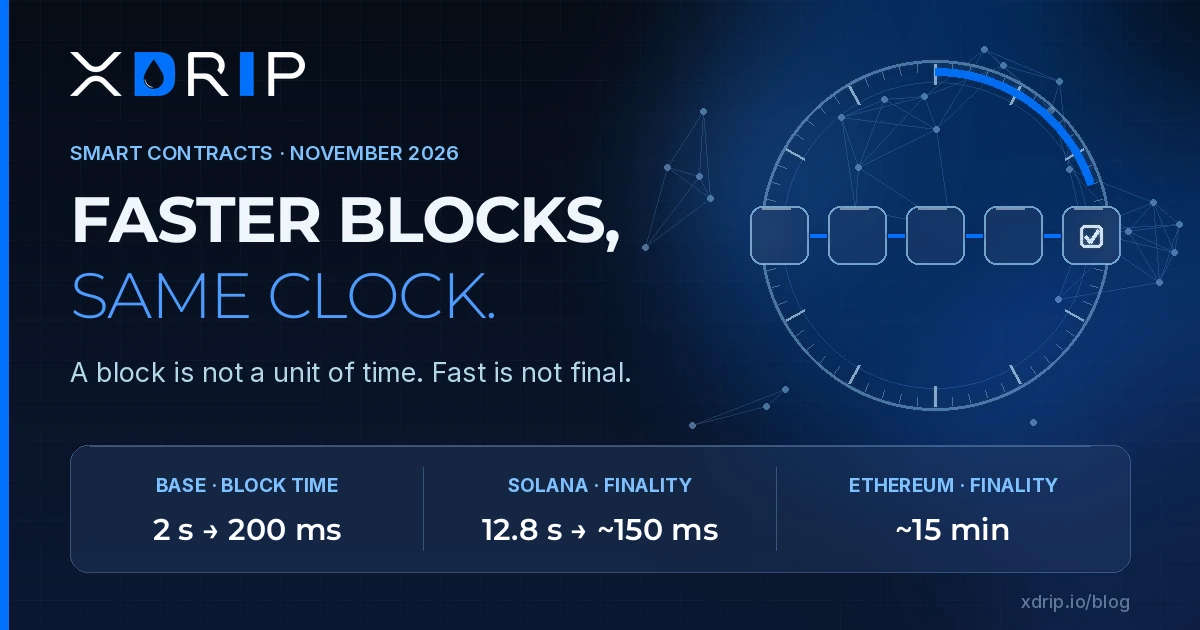
Two of the busiest networks in the industry changed their sense of time this autumn. On 21 October, Solana switched its consensus to Alpenglow and cut the time it takes for a transaction to become final from about 12.8 seconds to roughly 150 milliseconds. On 5 November, Base activated Denim and went from one block every two seconds to five full blocks every second.
Both upgrades are good news for anyone who builds payments, trading or record-keeping on these chains. Both also carry a quiet lesson for smart contracts: a block is not a unit of time, and a fast block is not the same thing as a final one.
Base: five blocks a second, and a shorter "block"
Base's announcement describes Denim as "five complete canonical blocks every second", replacing Flashblocks, the preview stream Base had layered over its two-second blocks. Each 200ms block now has its own number, hash and receipts, and the protocol enforces the interval: every block's timestamp must be exactly 200ms after its parent's. As The Block reported, the upgrade also adds BaseTime, which gives contracts access to millisecond timestamps, while the Ethereum-compatible block.timestamp stays in whole seconds.
The part that matters most for contract authors sits in Base's technical documentation. Because block.number now advances ten times faster in wall-clock time, any logic that treats a block count as a duration shrinks to one tenth of its intended length. Base lists the patterns affected:
- Timelocks, cooldowns and exit delays written as
block.number - start >= Nnow elapse ten times sooner. - Vesting and emission schedules measured in blocks complete ten times faster.
- Per-block rate limits reset five times per second instead of once every two seconds, raising the effective limit tenfold.
- Deadlines set as
block.number + Nexpire in a tenth of the planned time. - Governance voting windows counted in blocks, including the default block-number clock in
ERC20Votes, shrink by the same factor.
Base is direct about the hardest case: "Block-count constants baked into immutable or non-upgradeable contracts cannot be retuned." Logic that measures time with block.timestamp is unaffected. Its advice is to replace block-count durations with timestamp comparisons where a contract can be upgraded, multiply tunable durations by ten, divide per-block caps by ten, and plan a migration where nothing can be changed.
None of this is a flaw in Denim. It is a reminder that a number written into a contract carries an assumption about the network it runs on, and the network can change after the contract is deployed.
Solana: final in about 150 milliseconds
Alpenglow changes a different layer. According to Solana's upgrade page, it replaces TowerBFT, the consensus Solana had run since 2020. Validators now send votes directly to each other and aggregate them into certificates, so a block becomes final after one or two rounds of voting. Anza, the engineering firm that built it, explains that one track finalizes in a single round if 80% of stake responds and the other finalizes at 60% after two rounds, with both running side by side.
The Block noted the practical effect: the two-step confirmation process collapses into one, which matters for exchanges crediting deposits and merchants accepting payments. Solana's own page is careful about two details. First, the 150ms figure is how long a transaction takes to become final, not how often blocks are produced; block time was reduced separately, from 400ms to 200ms, in stages that finished in October. Second, the 150ms "is an expectation, not a constant": it depends on how stake is distributed and is lower when a block finalizes in one round than in two.
The execution layer did not change. Programs, transactions and fees stay the same. What changed is the distance between "my transaction ran" and "my transaction can no longer be reversed".
Fast is not final
The two upgrades are easy to read as the same headline, sub-second chains, but they answer different questions. Denim shortens the time until a transaction is included in a block. Alpenglow shortens the time until it is final.
Base says this plainly in its own announcement: "Including a transaction in a 200ms block does not by itself make it final." A Base block becomes safe when its batch is posted to Ethereum and final when Ethereum finalizes that batch. On Ethereum itself, ethereum.org still describes finality as taking about 15 minutes, with single-slot finality in the research phase.
So a user can see a transaction on Base within a fraction of a second, and the same transaction can still be minutes away from Ethereum finality. Both statements are true. Which one an application should act on depends on what is at stake: showing a balance update is one decision, releasing goods, crediting a withdrawal or recording a transfer of rights is another.
The trend is not limited to two networks. On 9 November, Kinetiq opened the Elysium public mainnet, a layer 2 for Hyperliquid that produces blocks every 100 milliseconds and settles to HyperEVM. Faster block production is becoming normal, and each new network adds its own definition of when a transaction is done.
What we take from this month's upgrades
When we read upgrade notes like these, four questions decide whether existing logic still means what it was meant to mean:
- Does any contract count blocks to measure time? Timelocks, vesting, voting periods and rate limits are the usual places. Where time matters, a timestamp is a sturdier reference than a block count.
- Which constants can still be changed? An upgradeable or governance-tunable parameter can be retuned. An immutable one needs an impact assessment and, if necessary, a migration plan.
- Which state does the application act on? Included, confirmed and finalized are different states, and on a layer 2 the last one is inherited from the chain it settles to. The state that triggers an irreversible action should be named explicitly, not assumed.
- Who has to update their integration? Base's retirement of Flashblocks and its "pending" semantics means indexers, wallets and dashboards that relied on them must move to standard block streams. Changes like this are easy to miss because nothing fails loudly.
Faster chains make better products possible. They also move the ground under assumptions that were written down when the chain was slower. A contract that records who owns what, or when value can be released, should state its sense of time in terms that survive the next upgrade.
Sources
- Base, Introducing Base Denim (November 2026)
- Base Docs, 200ms Native Blocks and Migrate From Flashblocks
- The Block, Base deploys Denim upgrade on mainnet, replacing Flashblocks with 200ms block times (5 November 2026)
- Solana, Alpenglow
- Anza, Alpenglow
- The Block, Anza's Alpenglow goes live on Solana, cutting finality to 150 milliseconds (21 October 2026)
- ethereum.org, Single slot finality
- Kinetiq, Kinetiq launches Elysium public mainnet (9 November 2026)