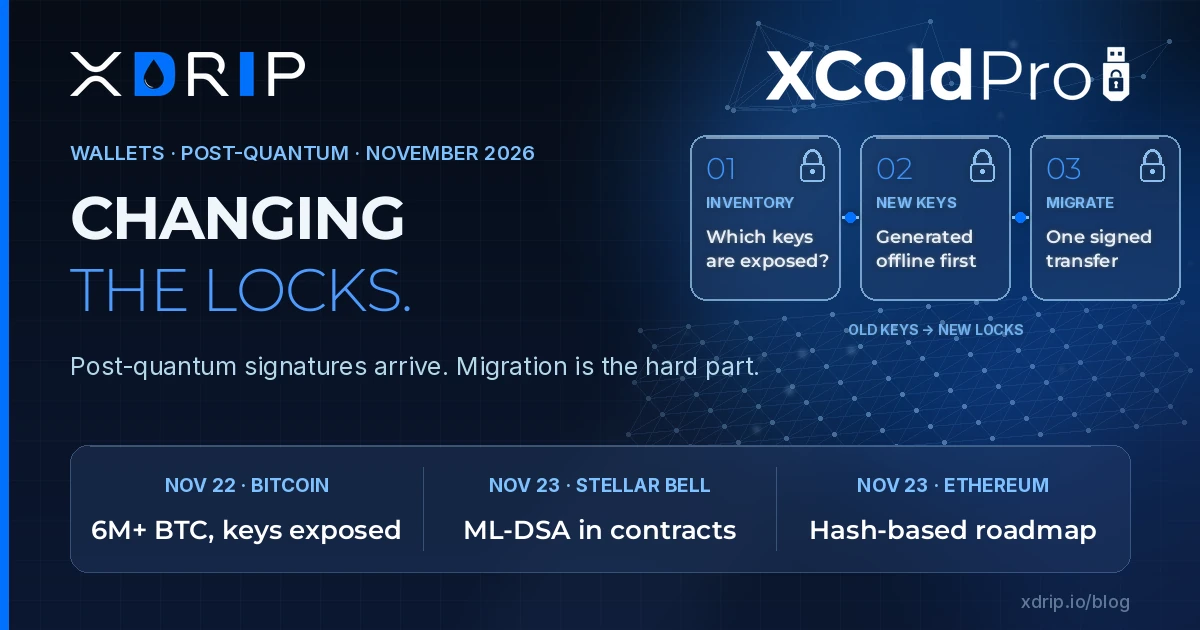
Two announcements on 23 November put a date-stamped shape on a problem the industry has discussed in the abstract for years. That evening, Stellar's validators activated Bell, Protocol 30, which lets smart contracts on the network verify a post-quantum signature standard. The same day, the Ethereum Foundation published the first post of a series called PQAI, setting out how it intends to move validators, user accounts and data commitments away from elliptic-curve cryptography. A day earlier, CoinDesk had laid out the other side of the ledger: on Bitcoin, more than 6 million coins sit behind public keys that are already visible on-chain.
None of this means today's keys are broken. No publicly known quantum computer can break the signatures that secure wallets today. What last week showed is that the cryptography is no longer the slowest part of the transition. The slowest part is moving keys, accounts and funds, and that work lands on wallets and the people who hold them.
A new lock, offered at the contract level
Stellar's Bell announcement describes three changes. The one that matters here, CAP-87, lets Soroban smart contracts verify ML-DSA signatures, one of the post-quantum signature schemes NIST standardised in 2024 as FIPS 204. Because verification is much heavier than for Ed25519, Bell performs it inside Stellar Core rather than in contract code, so the implementation is written and tested once against official test vectors instead of by every contract author. The mainnet vote was scheduled for 23 November at 17:00 UTC, and Stellar's public Horizon API now reports protocol version 30 as current.
The scope is deliberately narrow, and the Stellar Development Foundation says so. Network transaction signatures remain Ed25519; a native post-quantum signer for classic accounts is left to a future protocol change. What Bell provides is a building block: a custom account contract can now require a quantum-safe signature to spend. In the Foundation's words, that is what "wallets and custodians need before they can offer quantum-safe contract accounts". Bell also adds a new muxed contract address type starting with W, and the Foundation asks wallets and exchanges to accept it in validation, display and storage. Even an additive upgrade creates work at the wallet layer.
The CAP-87 specification shows the other cost. An ML-DSA-44 public key is 1,312 bytes and a signature 2,420 bytes; at ML-DSA-87 they grow to 2,592 and 4,627 bytes. An Ed25519 signature is 64 bytes. Every system that stores, transmits or displays keys and signatures has to absorb that difference.
A roadmap that changes the whole building
The Ethereum Foundation's PQAI #0 post goes further. It names three workstreams: validators signing with hash-based keys, so finality no longer depends on elliptic curves; wallets giving users "a straightforward way to move to hash-based signatures"; and blobs switching to hash-based commitments. After more than a year of evaluating candidate schemes, the Foundation is advocating hash-based cryptography because the protocol already relies on hashes being secure, so it adds no new assumption.
The timing has also shifted. The post cites December 2028 as a target put forward at Devcon, with 2029 as the Foundation's internal deadline and a timeline review planned for January. It names AI, not only quantum computing, as the more urgent driver: models are already finding bugs in production software faster than people can review them. The Foundation says it has doubled its protocol security team, and lists the cost plainly: wallets, multisigs and staking pools all need changes, and much larger signatures affect hardware requirements for running nodes. Its closing line sums up the task: "This time we change the locks."
The tenants who have not moved
Bitcoin shows why the lock is the easy part. In its 22 November report, CoinDesk cited Glassnode data showing that more than 6 million BTC, 31.2 percent of circulating supply, were held behind public keys already visible on-chain in October. Those coins are safe today. But a sufficiently capable quantum computer could use an exposed public key to take control of the funds behind it, and moving them requires their owners to act.
Bitcoin has no agreed path yet. BIP-360, which proposes a Pay-to-Merkle-Root output type to reduce exposure to certain quantum attacks, and BIP-361, which outlines a phased sunset of legacy signatures, are both still marked Draft in the official repository. Developers disagree on whether coins that never migrate should eventually be restricted or left as they are. As Cysic's Leo Fan put it to CoinDesk, "coins that never move are a social problem, not a technical one."
The same report points to a gap that matters for anyone holding significant value: post-quantum signatures for a single signer are standardised, but threshold and multisig versions are still at the research stage. NIST issued a call for multi-party threshold cryptography proposals in January, and BitGo and Silence Laboratories completed a simulated post-quantum MPC transaction in May without announcing a production deployment. Custody setups that split control across several parties will therefore wait longer than single-key wallets.
What a migration actually asks of a holder
Read together, these developments describe a migration with a familiar structure, regardless of chain:
- Inventory first. A holder needs to know which addresses have already exposed a public key, which have not, and which keys protect what. Reused addresses and old outputs are the weak points.
- New keys before new funds. A post-quantum account is a new key and, in most designs, a new address or account contract. It has to be generated, backed up and tested before value moves into it.
- The move is a transaction. Migration is not a setting. It is a signed transfer from old cryptography to new, and it carries every ordinary transaction risk: wrong destination, wrong network, wrong amount.
- Larger artefacts. Keys and signatures measured in kilobytes change what backups, signing devices and transfer formats must carry.
- Multi-party setups wait longest. Until threshold and multisig schemes catch up, shared-control arrangements may need interim designs.
None of these steps is new. They are the same disciplines self-custody has always required, applied to a migration that will eventually involve most long-held assets.
Where XColdPro fits
As XDRIP Digital Management LLC, we build XColdPro, an air-gapped cold storage security platform. Cold storage exists for assets that are meant to stay put for a long time, which is exactly the category a signature migration touches last and most carefully. Our view is that the safest migration is a planned one: an inventory of what is held where, a new key generated and backed up offline, and a transfer that is reviewed and signed away from networked devices. The new locks are arriving chain by chain. Moving into them is still a key-management job, and that is where we focus.
Sources
- Stellar Development Foundation, Introducing Bell, Protocol 30 on Stellar
- Stellar, CAP-87 specification and Horizon API, mainnet status (protocol 30, checked 24 November 2026)
- NIST, FIPS 204: Module-Lattice-Based Digital Signature Standard
- Ethereum Foundation, PQAI #0: Preparing Ethereum for a post-quantum, post-AI world (23 November 2026)
- CoinDesk, Bitcoin's quantum security challenge extends to bridges, custodians and millions of coins (22 November 2026)
- Bitcoin BIPs repository, BIP-360 and BIP-361